2Bridge

Bridging Frontier Reasoning and Robot Execution:
From Autonomous Demonstration Generation
to Dense Language Supervision

1University of California, San Diego2NVIDIA

How can we bridge frontier intelligence and robot actions?

Five interfaces for robot control, distinguished by what the model outputs and how it becomes physical action.
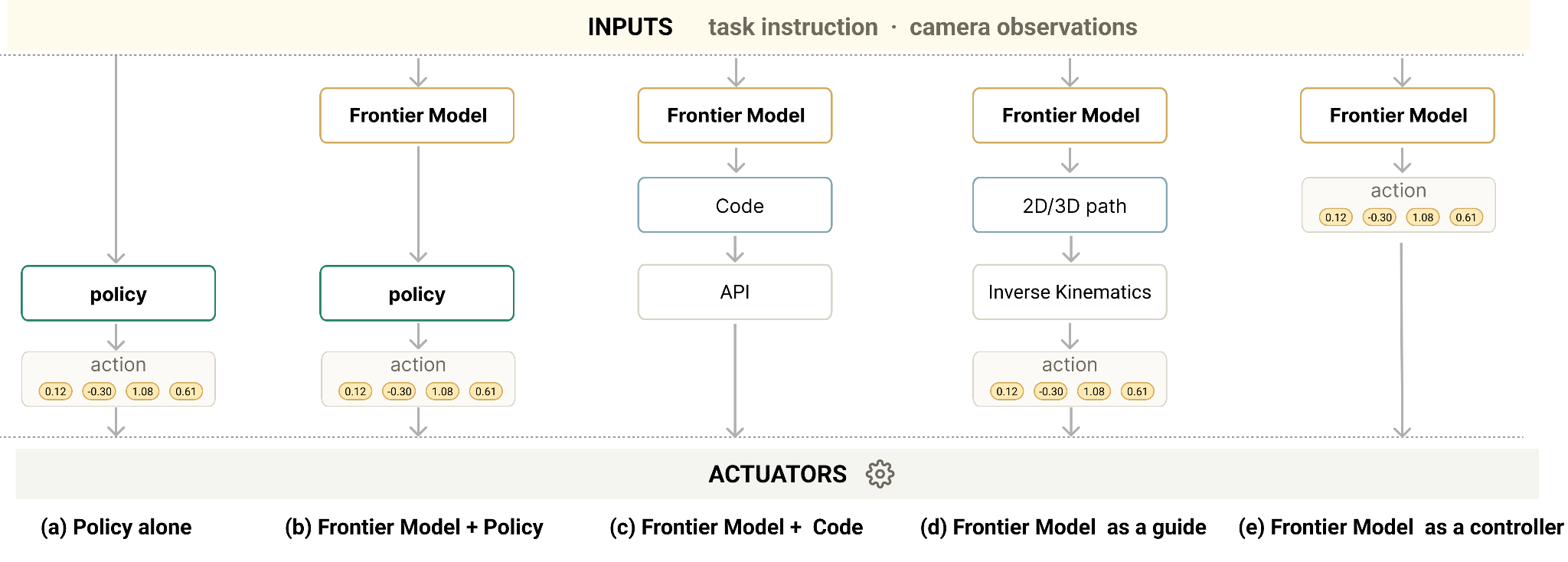
Five interfaces connect task instructions and camera observations to robot actions: a local policy, frontier instructions for a policy, generated code, geometric paths, and direct action commands.

Two bridges between reasoning and execution

Bridge 1 · Autonomous demonstration generation

Autonomous rollouts via in-context learning

We provide five human demonstrations, then let the model control the robot.
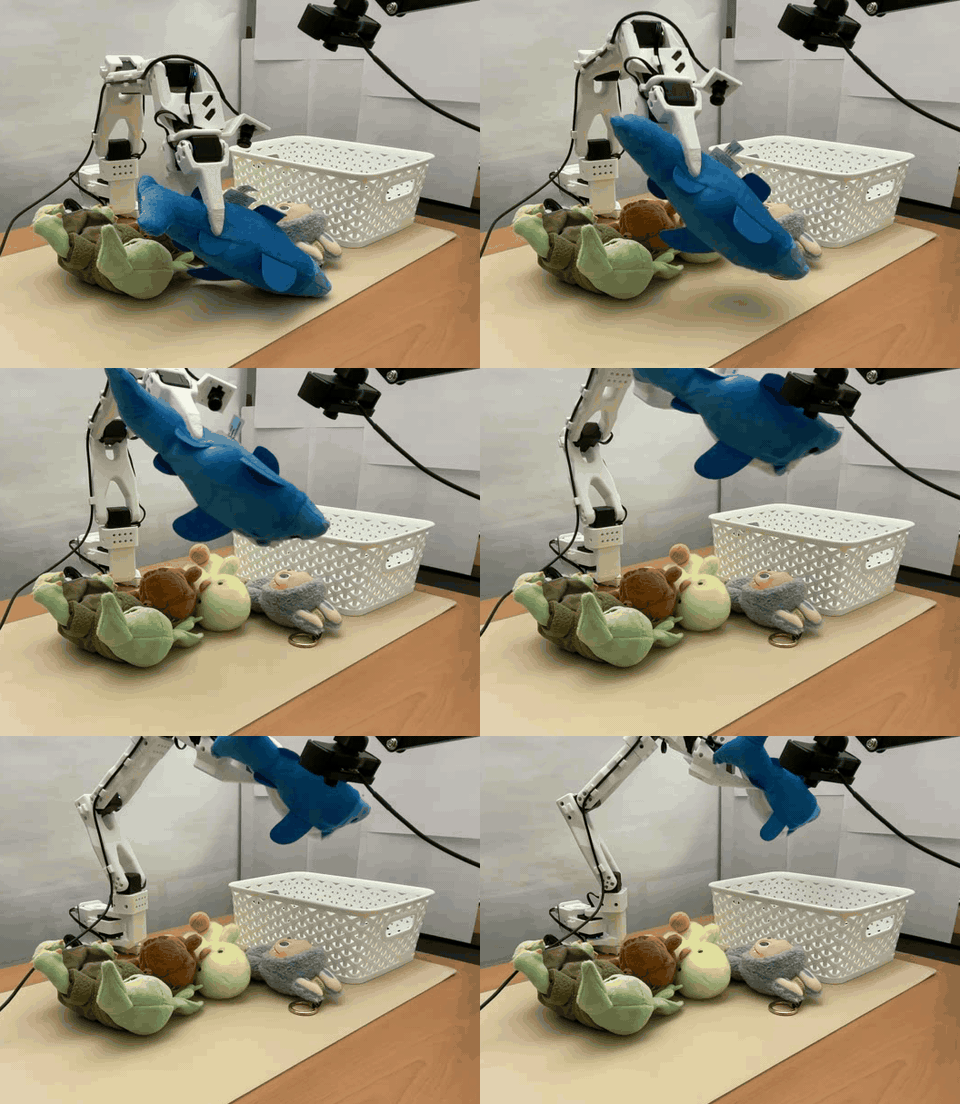
Claw machine

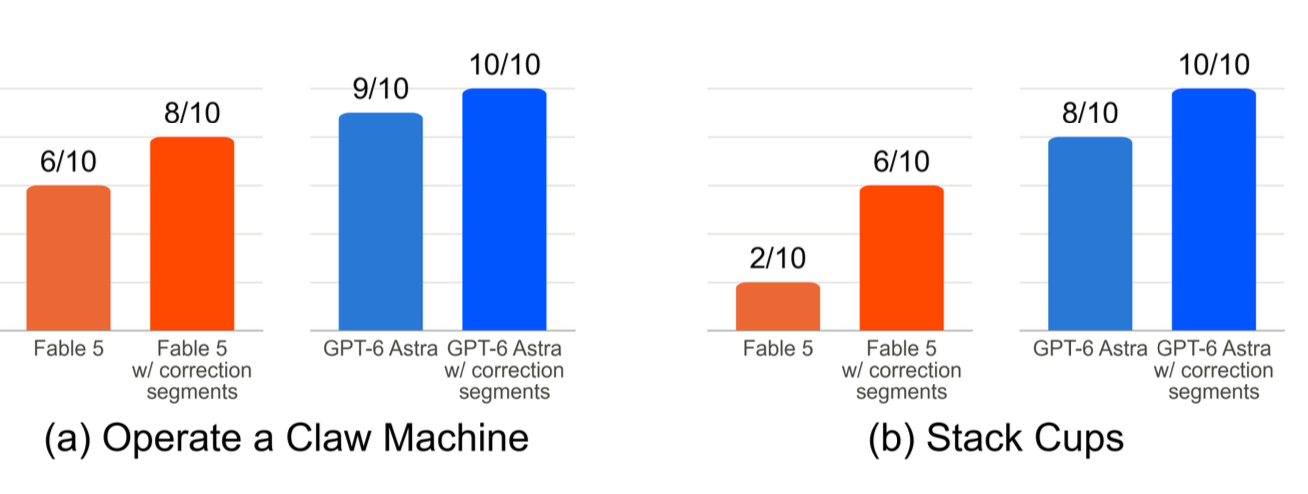
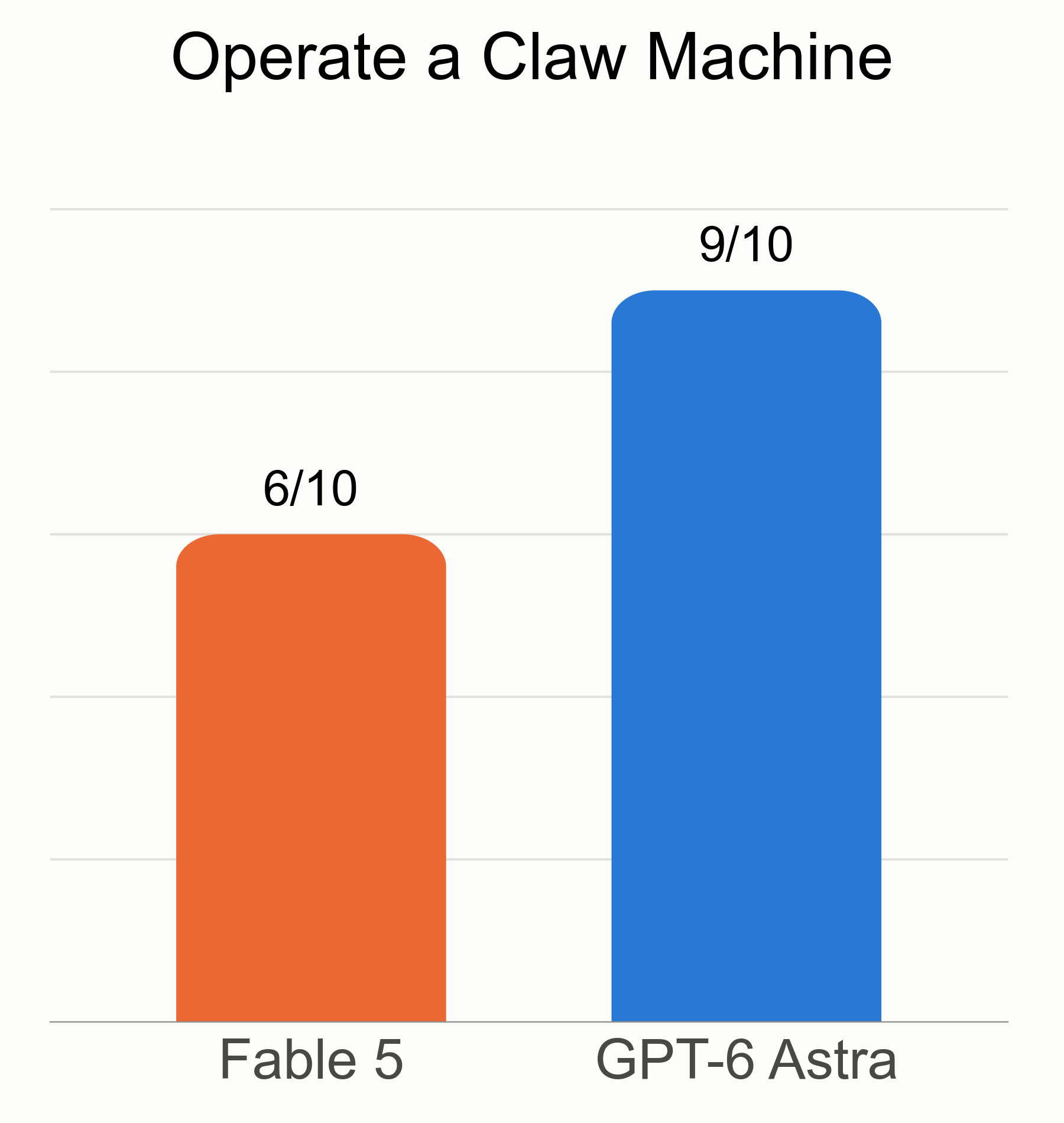
Autonomous robot rollout: claw machine. Fable 5: 6/10. GPT-6 Astra: 9/10.

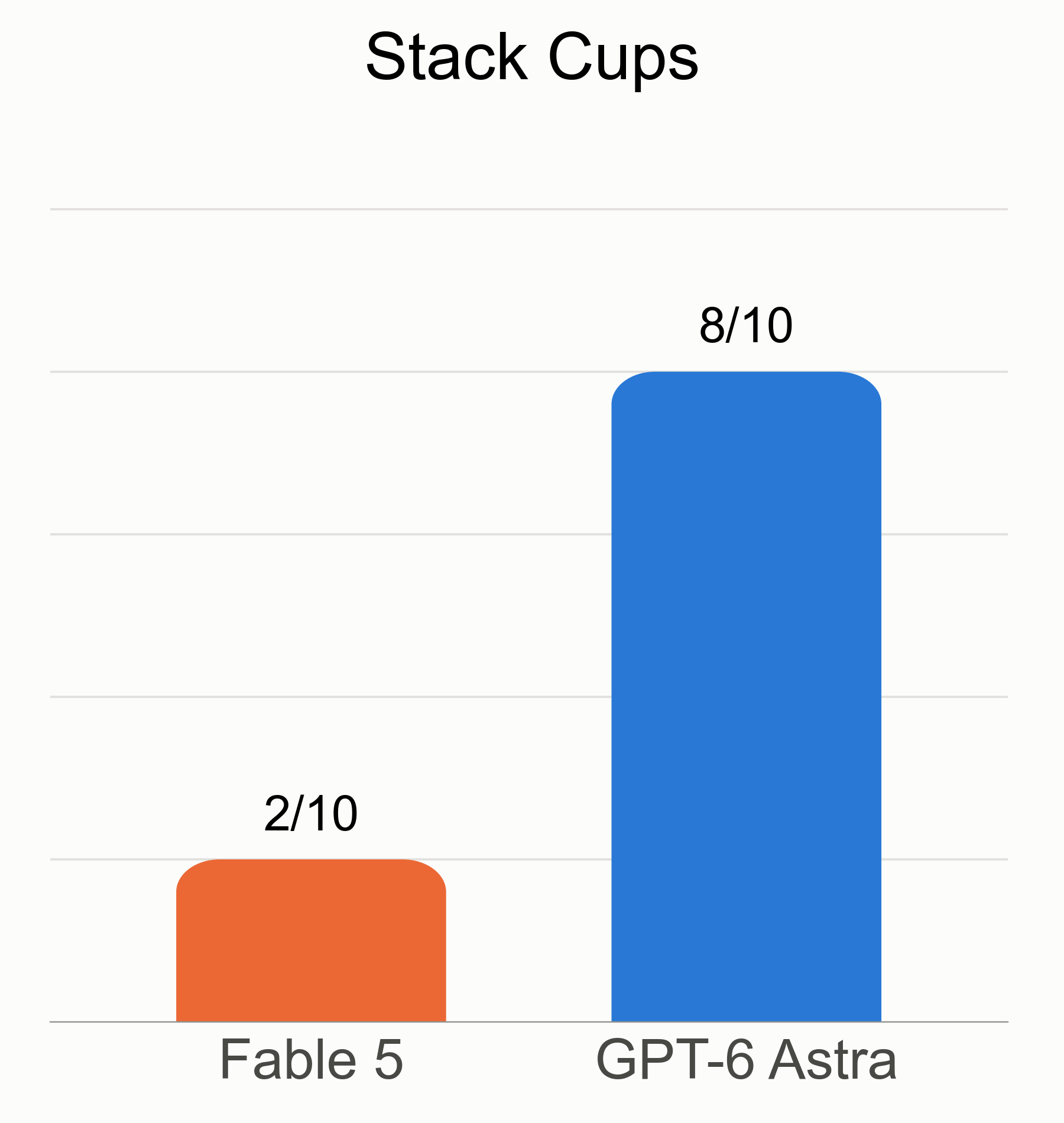
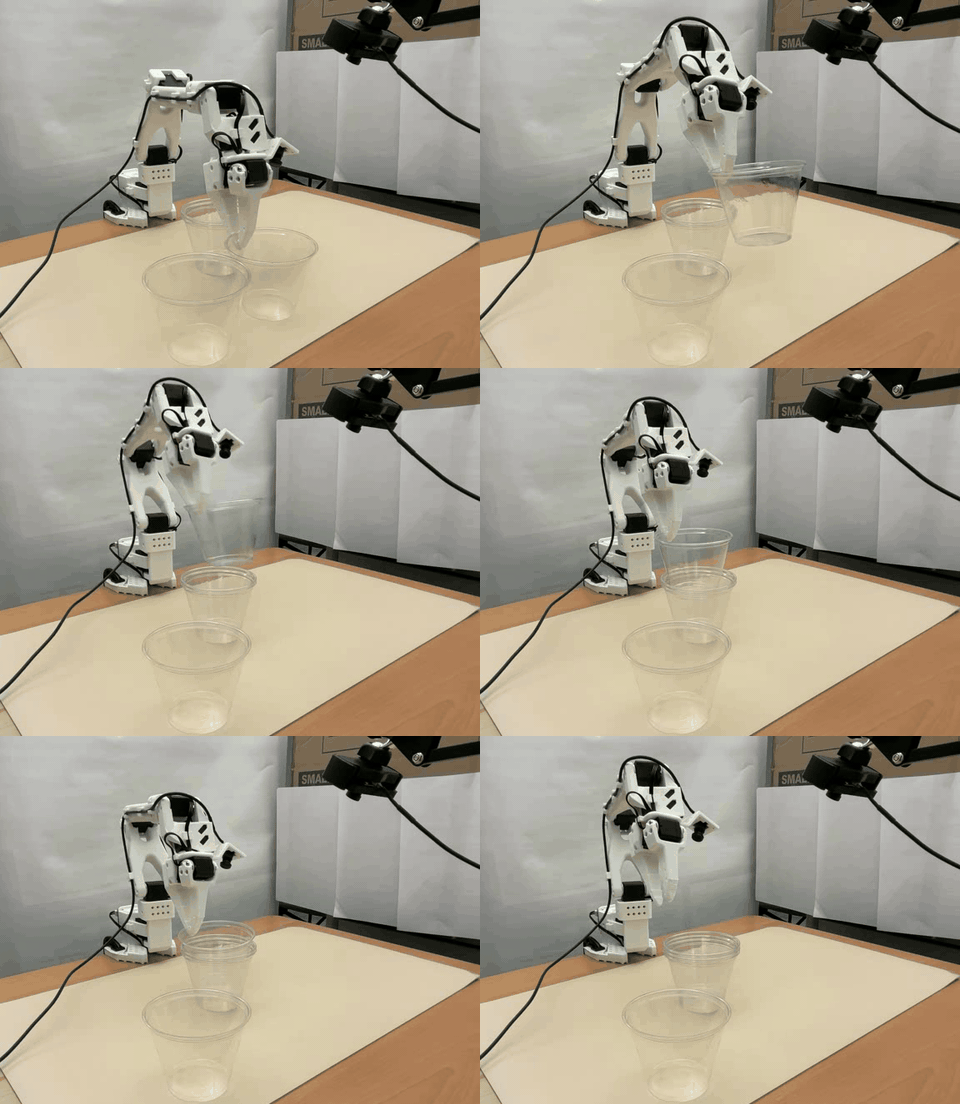
Stack cups

Autonomous robot rollout: stack cups. Fable 5: 2/10. GPT-6 Astra: 8/10.

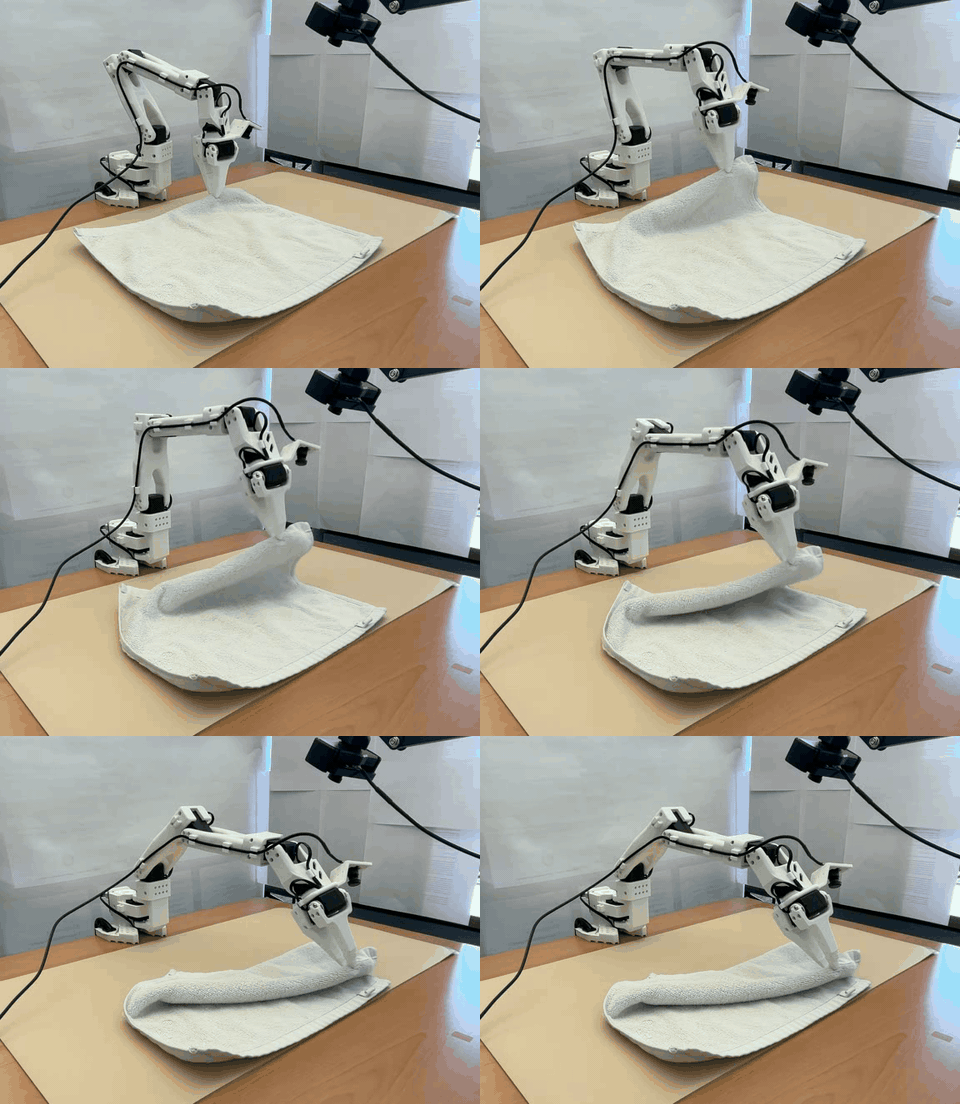
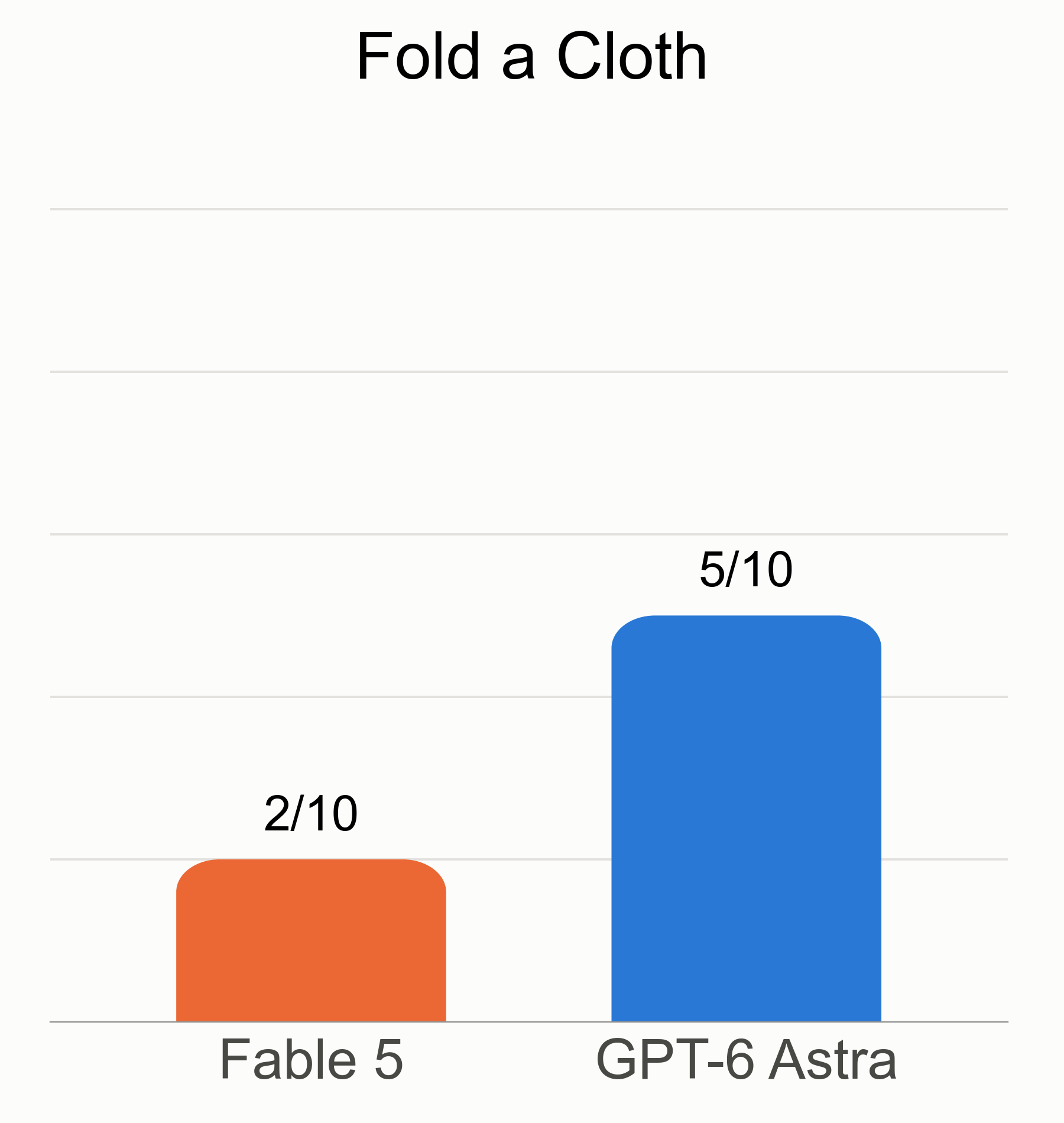
Fold a cloth

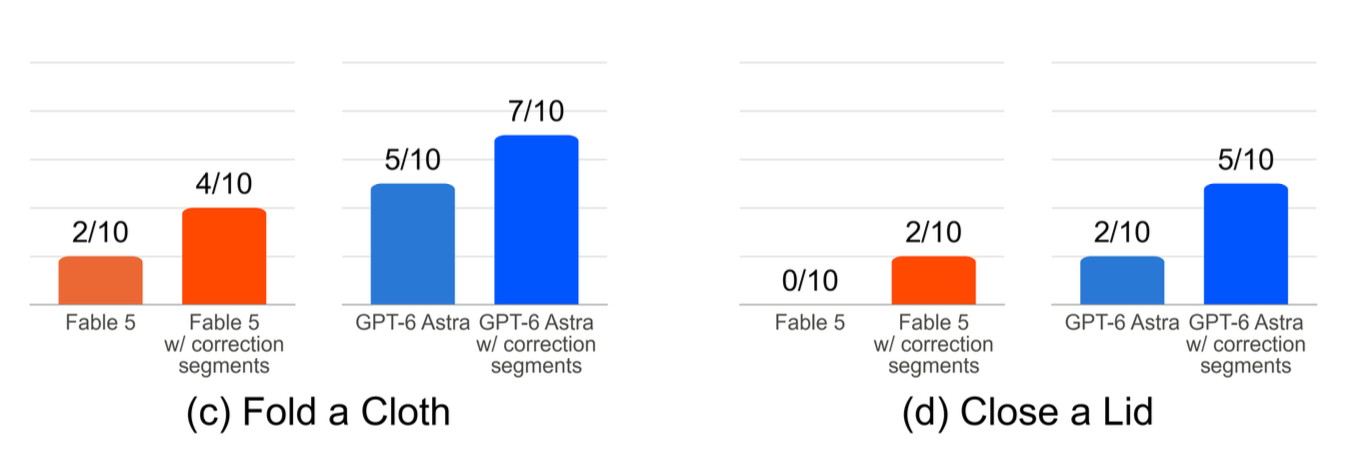
Autonomous robot rollout: fold a cloth. Fable 5: 2/10. GPT-6 Astra: 5/10.

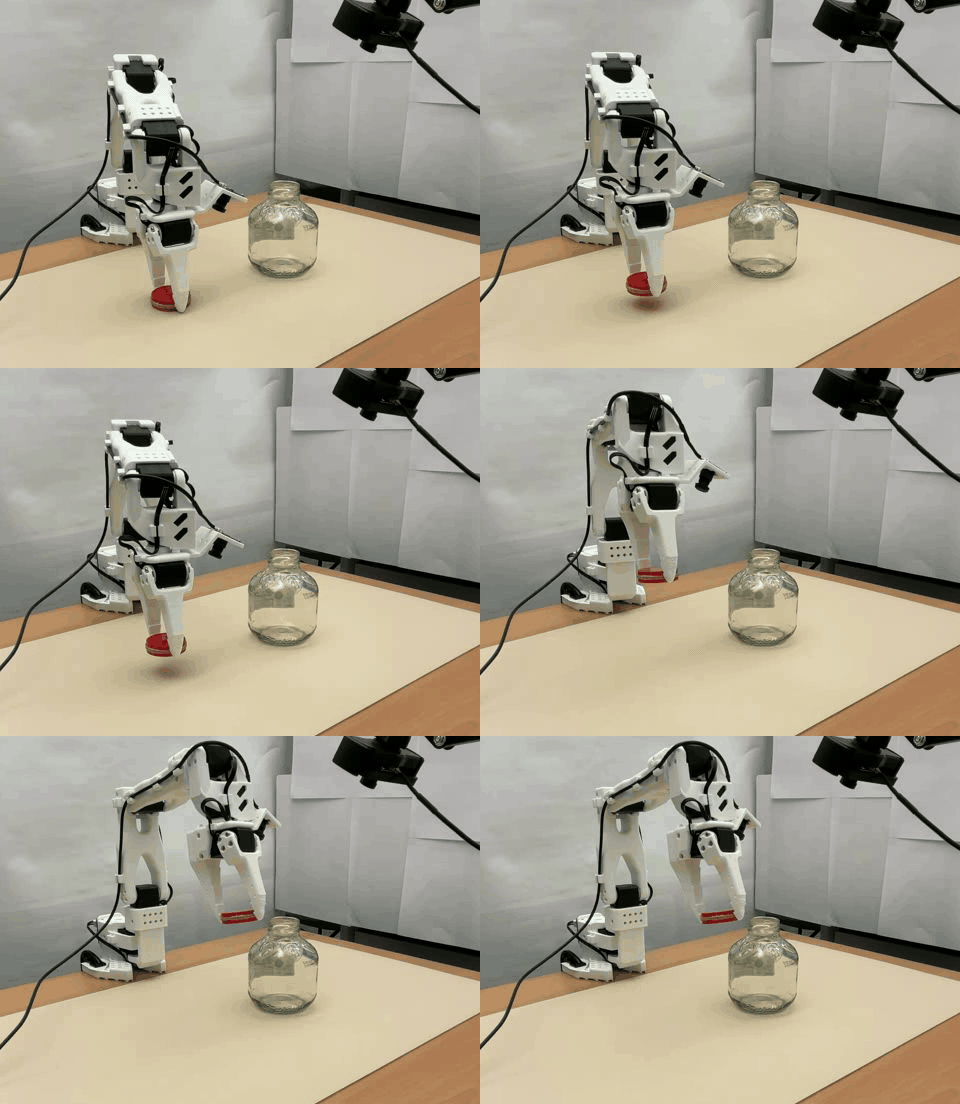
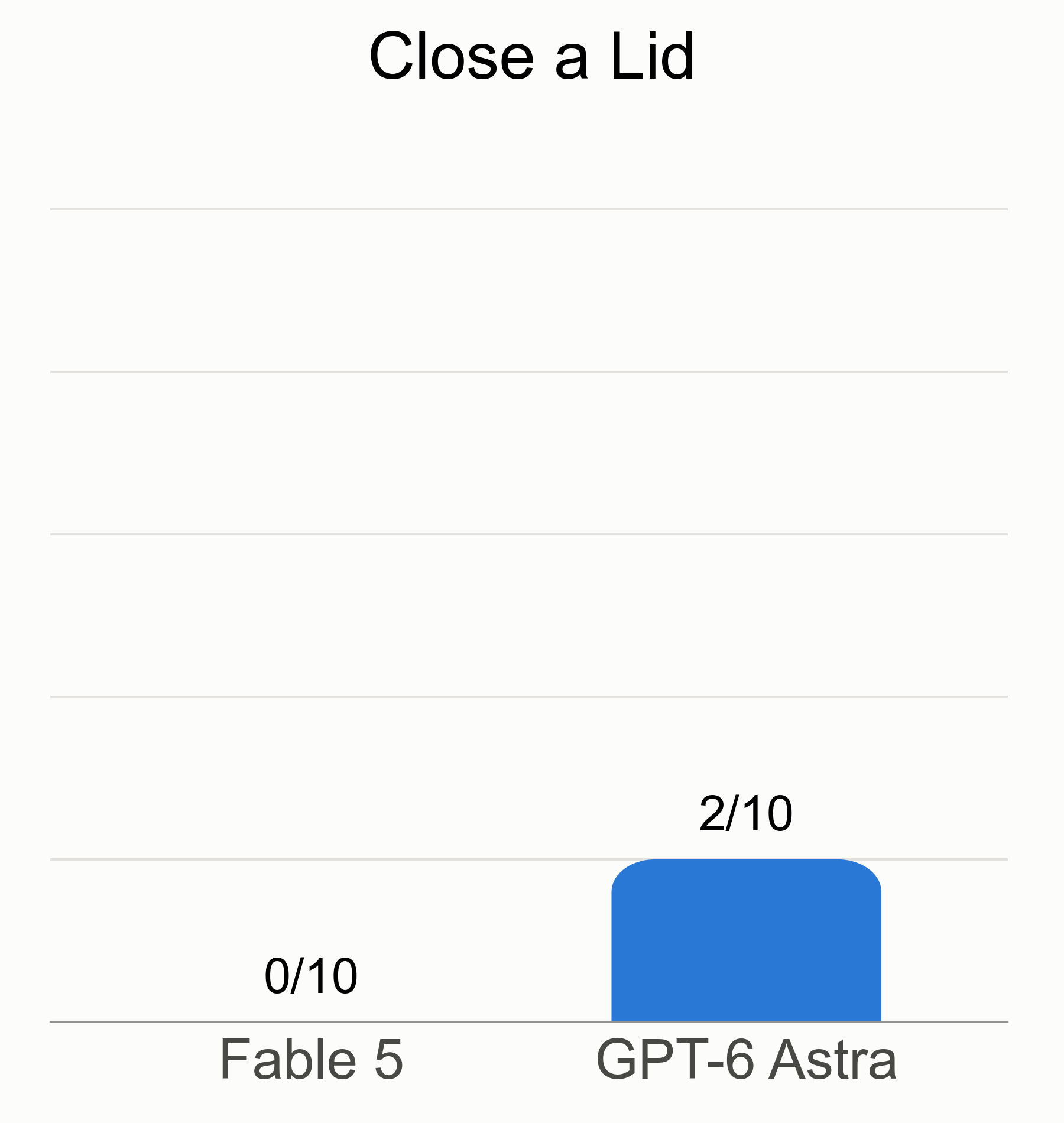
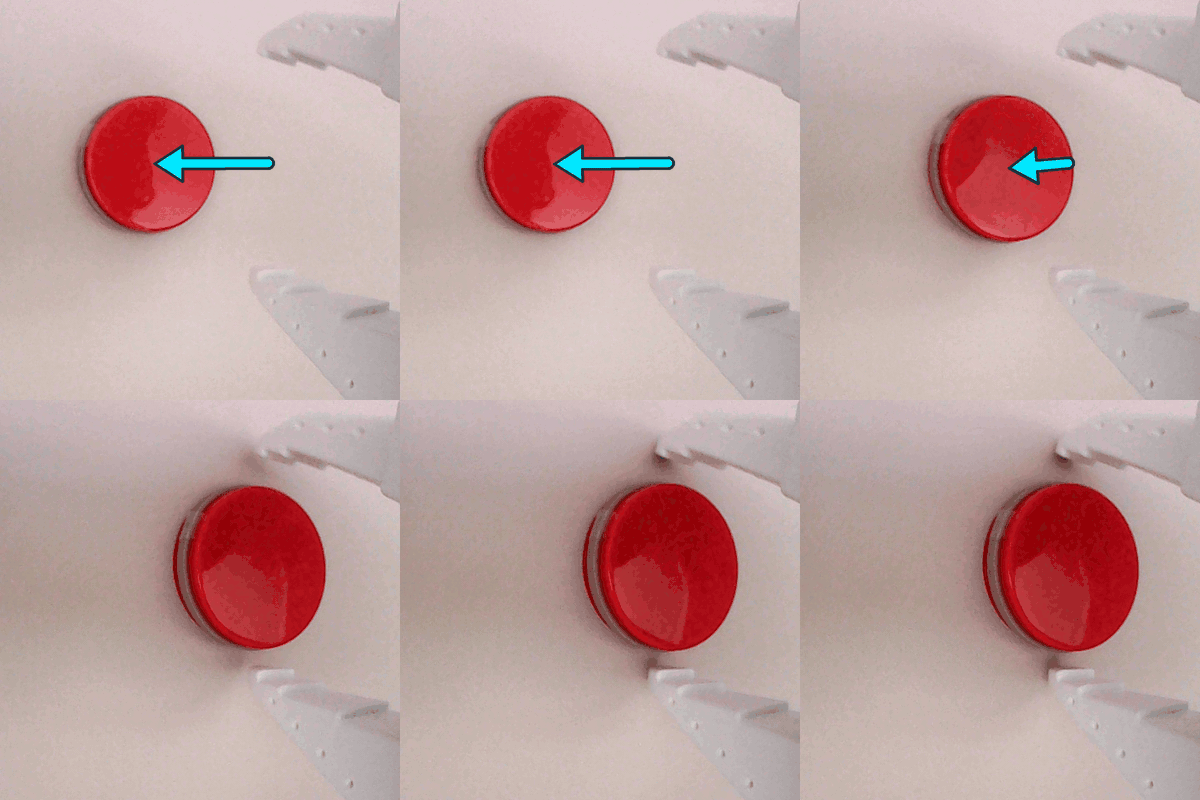
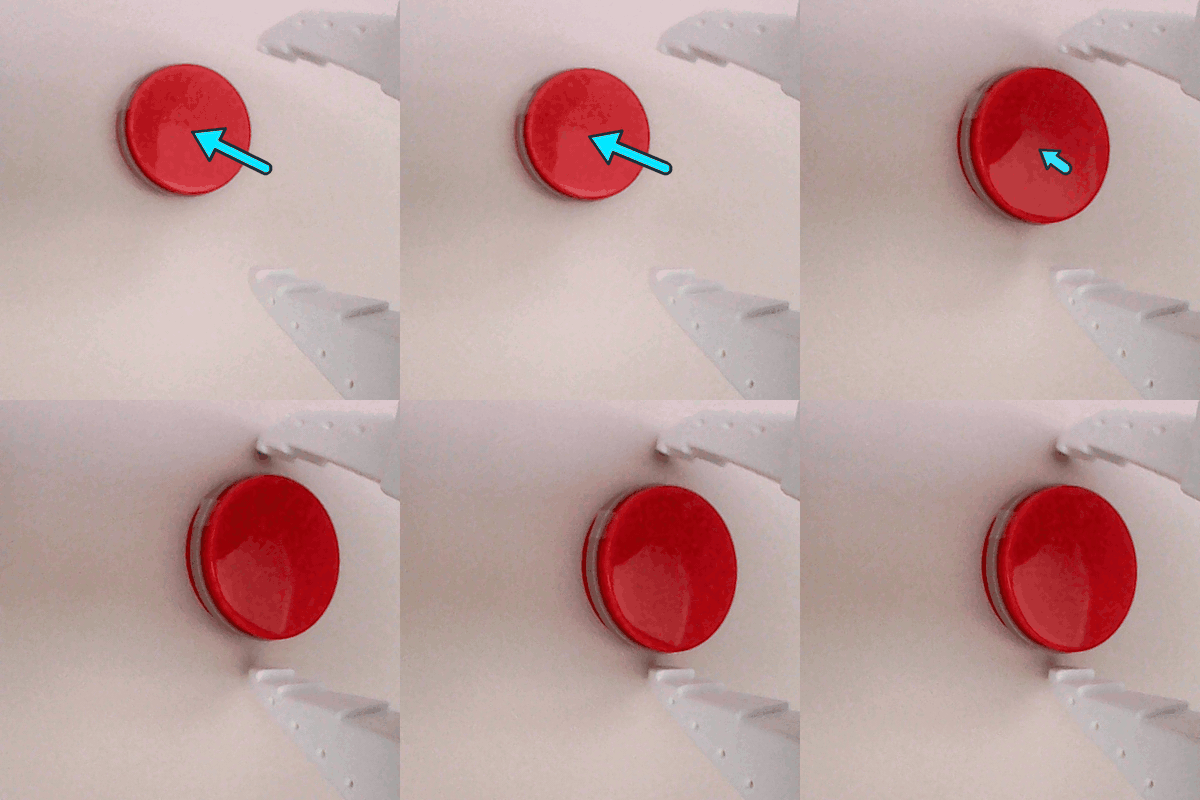
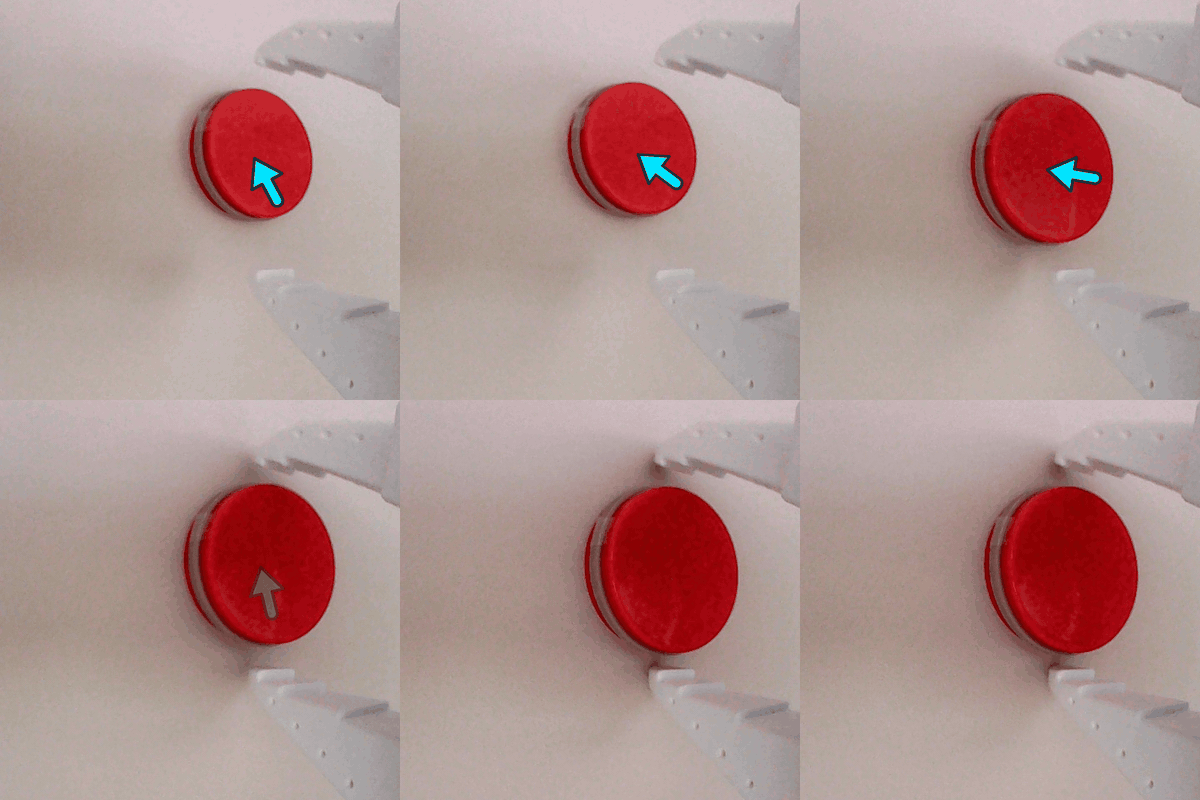
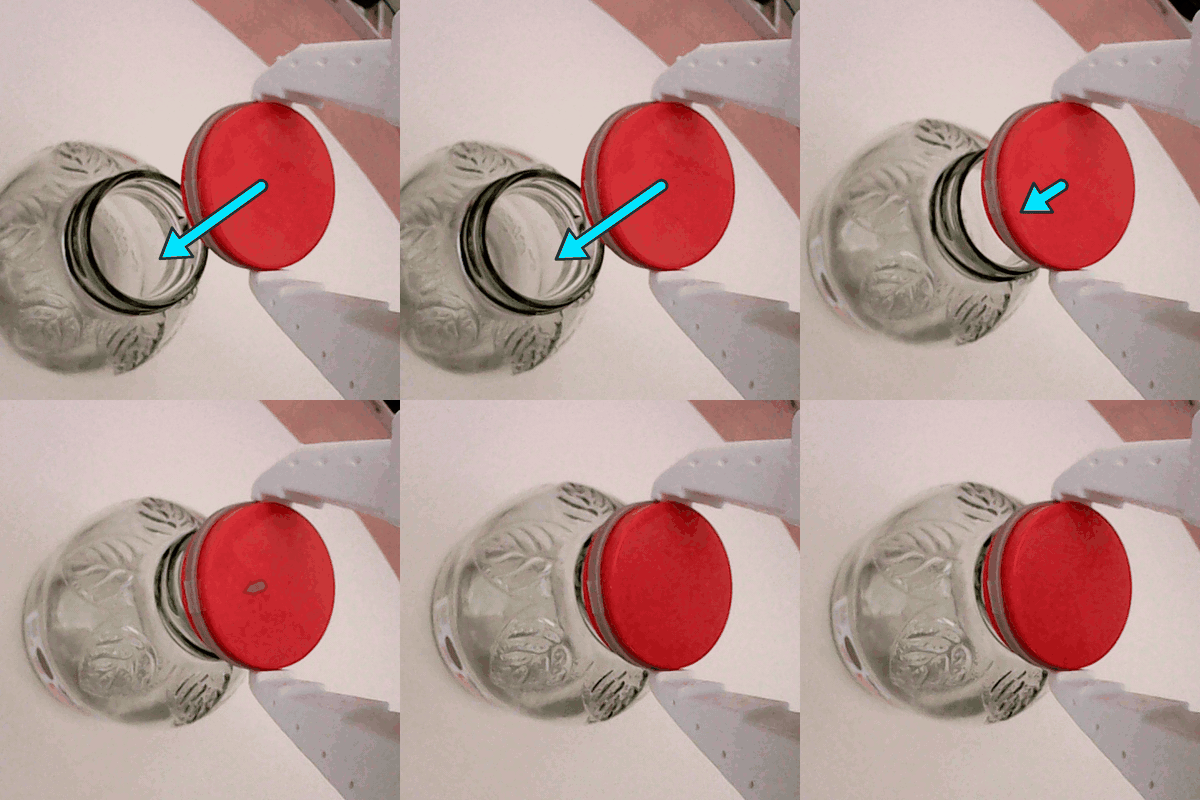
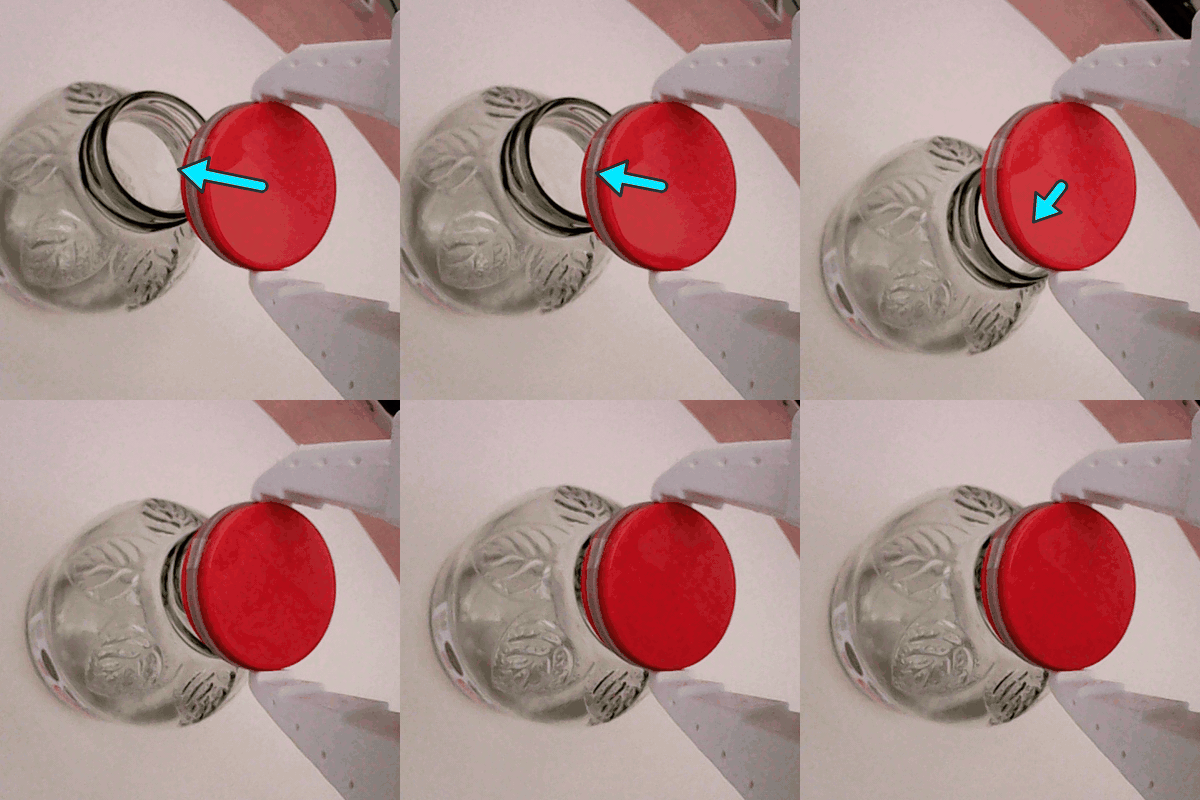
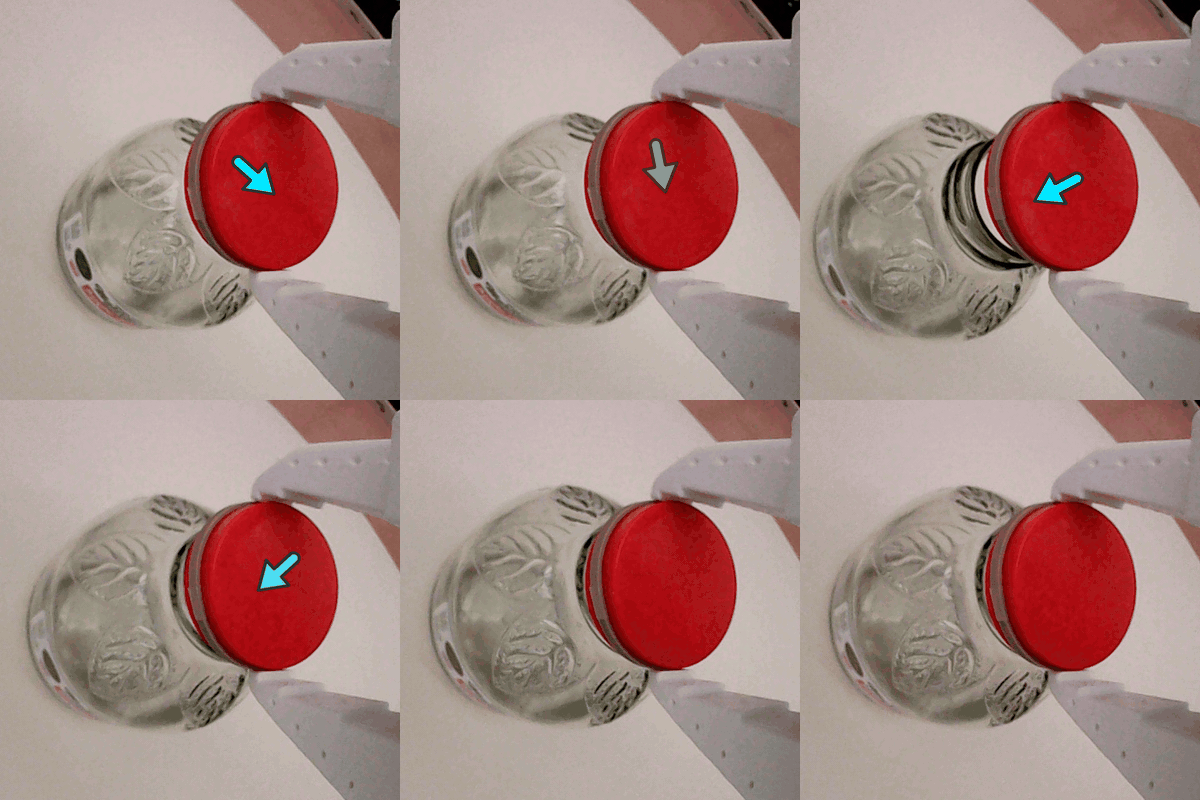
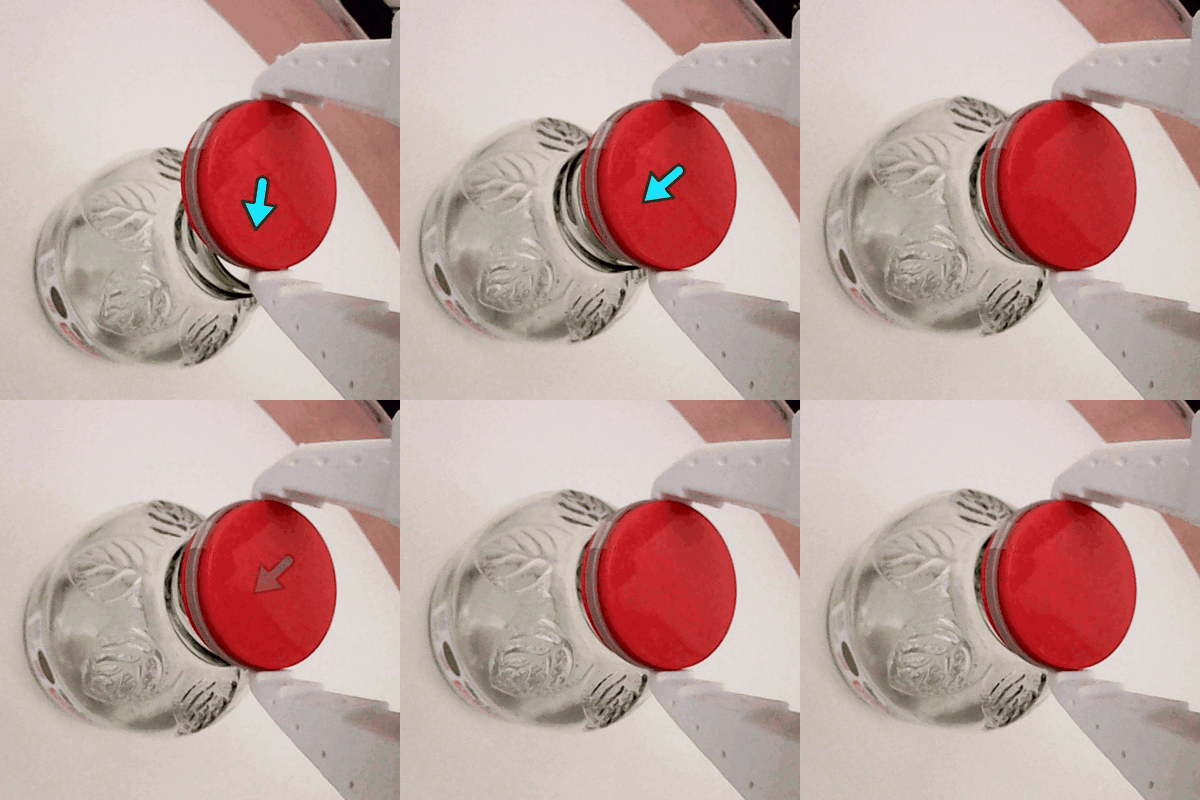
Close a lid

Autonomous robot rollout: close a lid. Fable 5: 0/10. GPT-6 Astra: 2/10.

Successes out of 10 independent trials per model and task.

Successful examples alone are not enough for precise contact.

Show the model how to correct errors

Corrective demonstration segments teach small adjustments when execution goes wrong.
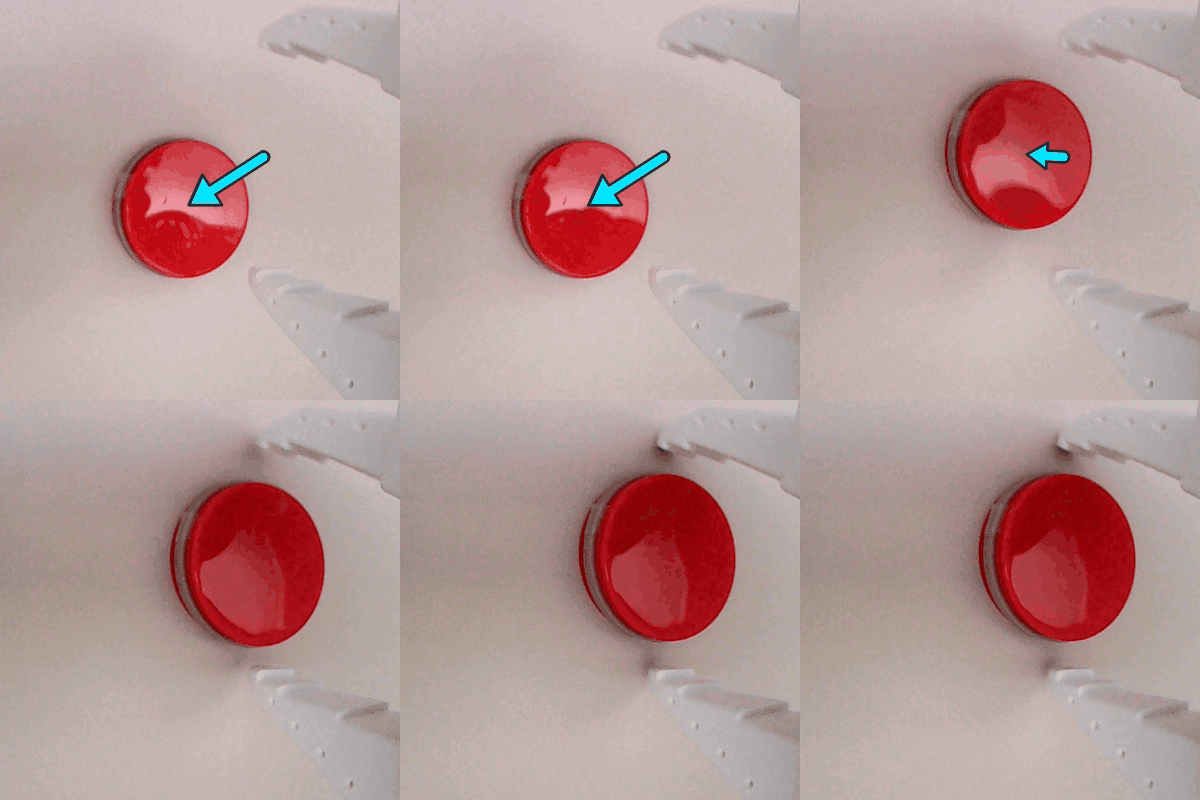
Corrective demonstration segment: grip, north adjustment.
Grip · North
Corrective demonstration segment: grip, east adjustment.
Grip · East
Corrective demonstration segment: grip, south adjustment.
Grip · South
Corrective demonstration segment: grip, southwest adjustment.
Grip · Southwest
Corrective demonstration segment: place, northeast adjustment.
Place · Northeast
Corrective demonstration segment: place, east adjustment.
Place · East
Corrective demonstration segment: place, southwest adjustment.
Place · Southwest
Corrective demonstration segment: place, northwest adjustment.
Place · Northwest
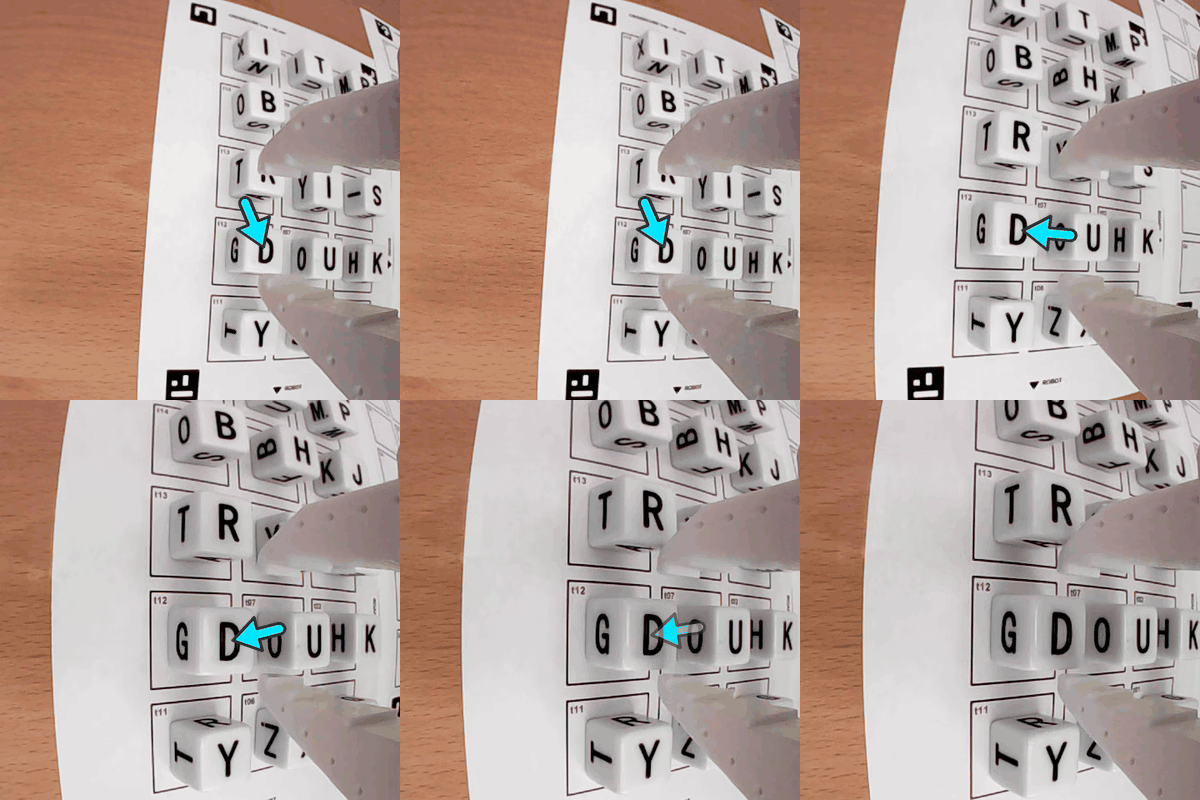
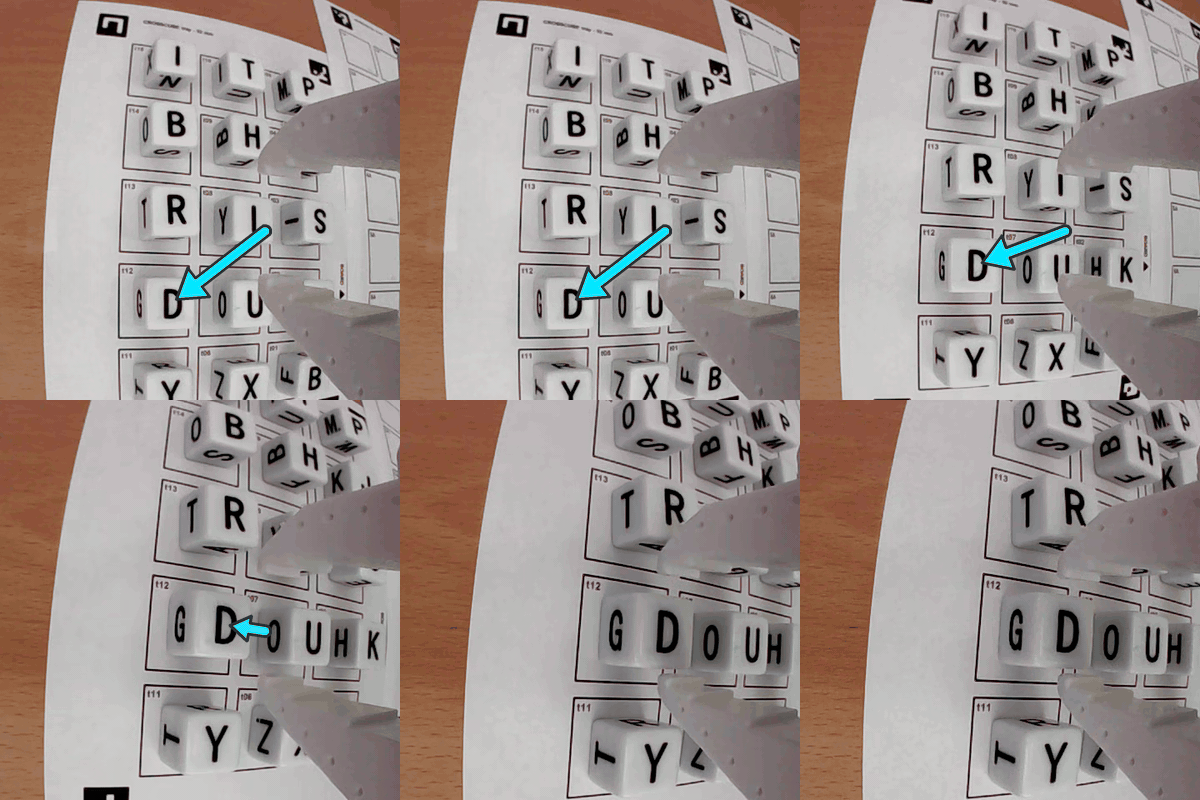
Crosscube corrective demonstration: grip adjustment, left.
Crosscube · Left
Crosscube corrective demonstration: grip adjustment, right.
Crosscube · Right
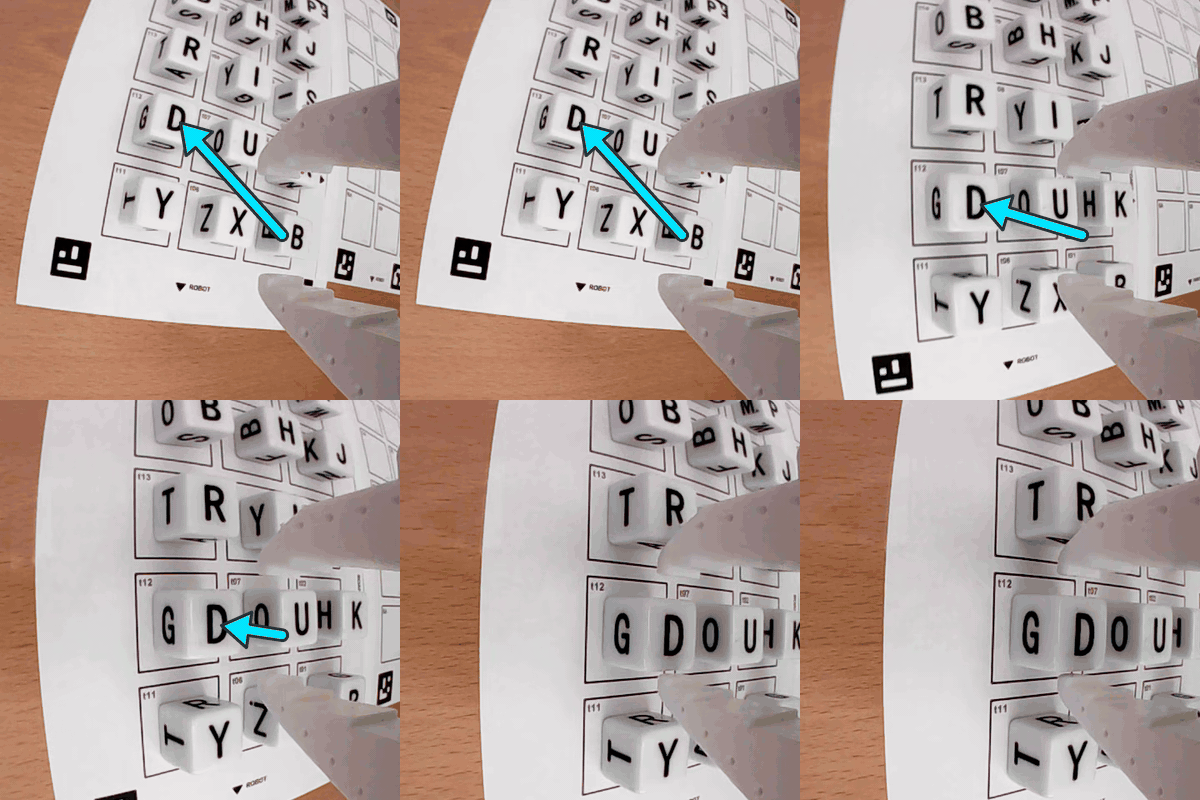
Crosscube corrective demonstration: grip adjustment, nearer.
Crosscube · Nearer
Crosscube corrective demonstration: grip adjustment, farther.
Crosscube · Farther
Corrective segments improve both models on claw machine and stacking cups. Astra reaches 10/10 on both tasks. With corrective segments, Fable improves from 2/10 to 4/10 on cloth and 0/10 to 2/10 on lid; Astra improves from 5/10 to 7/10 and 2/10 to 5/10.

With corrective examples, autonomous generation succeeds more often across all four tasks.

Generation efficiency with accumulated examples

Reuse successful segments. Spend less time and API cost on the next rollout.
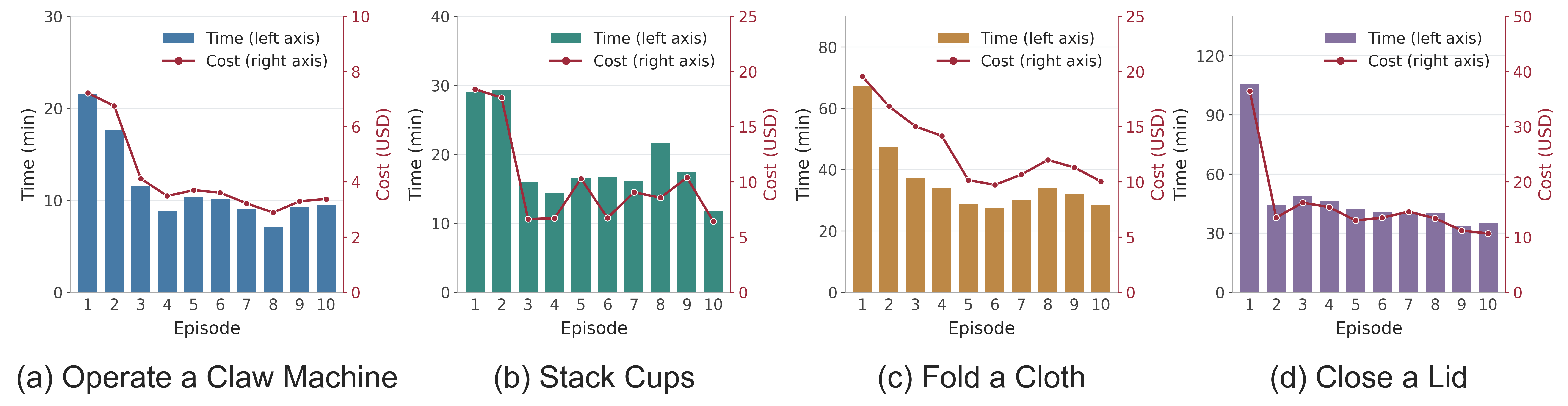
Generation time and API cost across ten successful episodes for claw machine, stacking cups, folding cloth, and closing a lid.
Figure 4 · Time in minutes (bars) and API cost in USD (lines). Successful episodes only; failed attempts excluded. View full size.Swipe to explore the full figure.

Frontier guidance. Faster local execution.

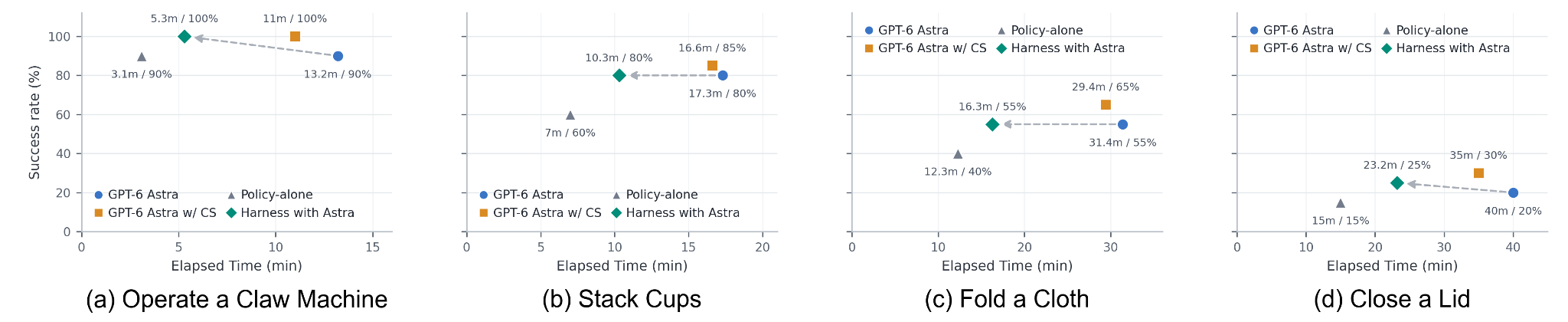
51.25% 65%Success: local policy → harness
40–60% less timeVersus direct frontier control, on successful trials
Success and elapsed time across four tasks: harness control improves the balance between success and execution time compared with direct Astra control or policy alone.
20 trials per task and configuration. Elapsed time averages successful trials only. View full size.Swipe to explore the full figure.

Bridge 2 · Dense language supervision

One trajectory. Many ways to guide it.

Teach the local policy at every scale, with varied language.
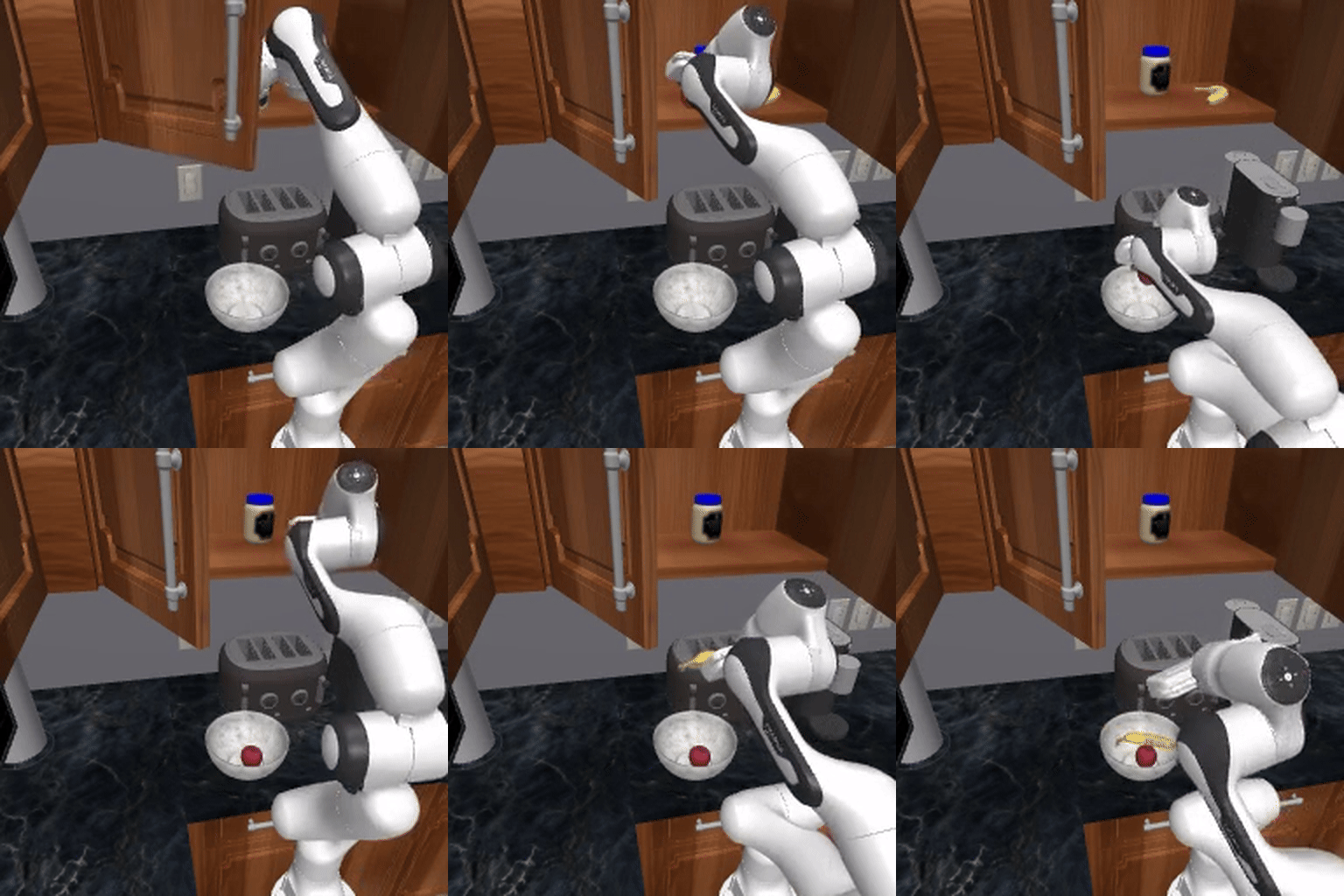
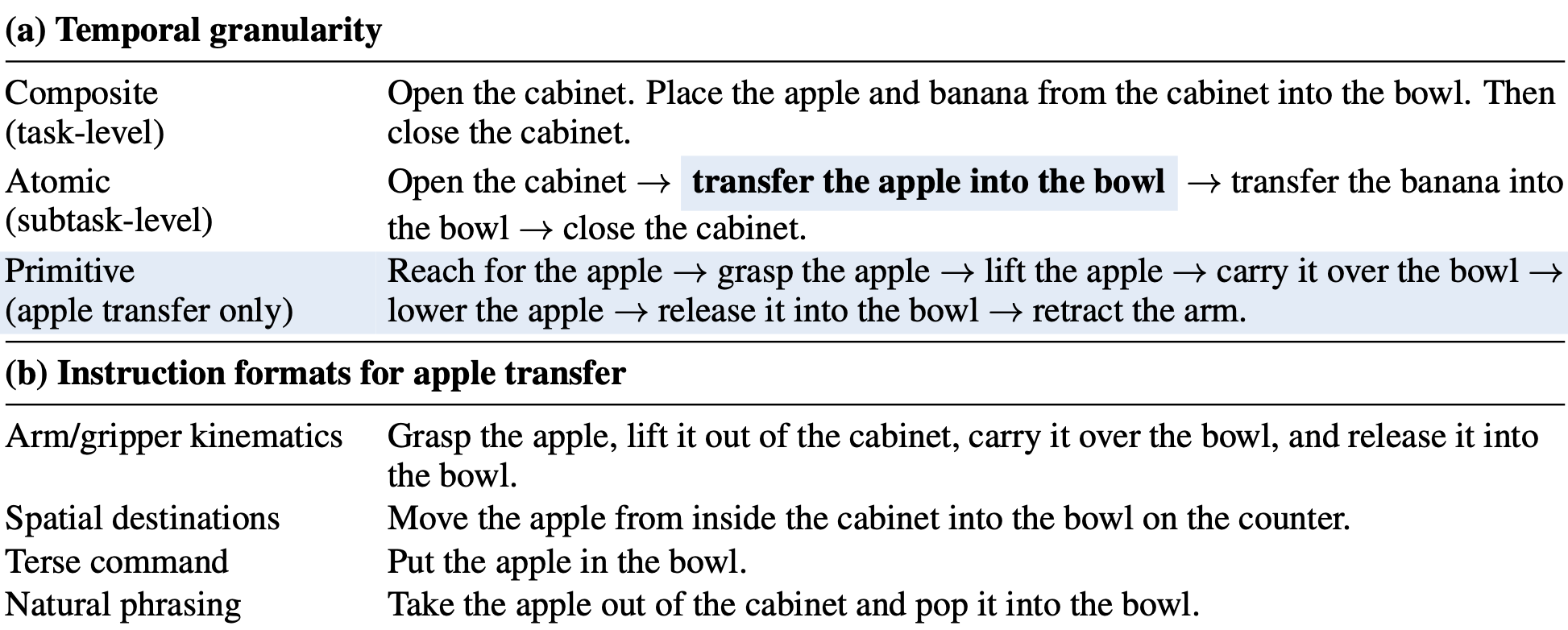
A robot transfers an apple from a cabinet into a bowl.
The same movement, richly annotated.

From task to movement

  1. Composite · Task

    Open the cabinet, transfer the fruit, close the cabinet.

  2. Atomic · Subtask

    Transfer the apple into the bowl.

  3. Primitive · Movement

    Reach → grasp → lift → carry → lower → release → retract.

Different words, the same goal

  • “Put the apple in the bowl.”
  • “Move the apple from inside the cabinet into the bowl on the counter.”
  • “Take the apple out of the cabinet and pop it into the bowl.”
View full annotation examples

Fine-grained commands. More reliable execution.

Compliance with individual movement instructions.
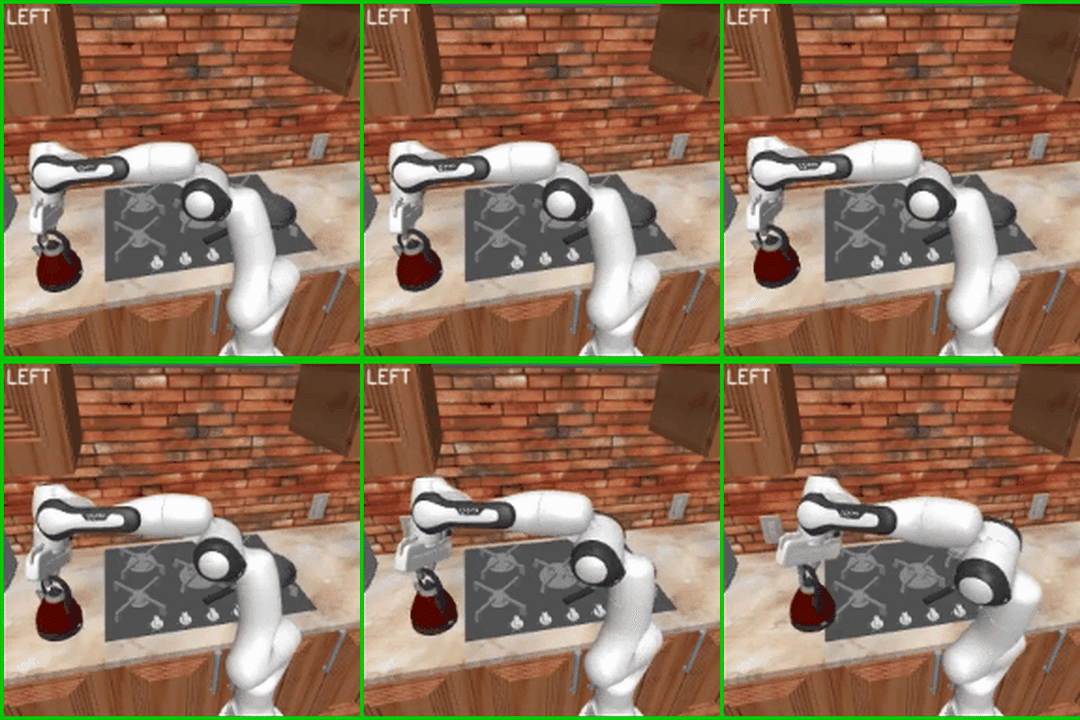
“Lift the object up”

Illustrative demonstration: the robot lifts a red kettle while the arm and kettle remain visible.
Baseline
25.0%
Hierarchical
83.3%

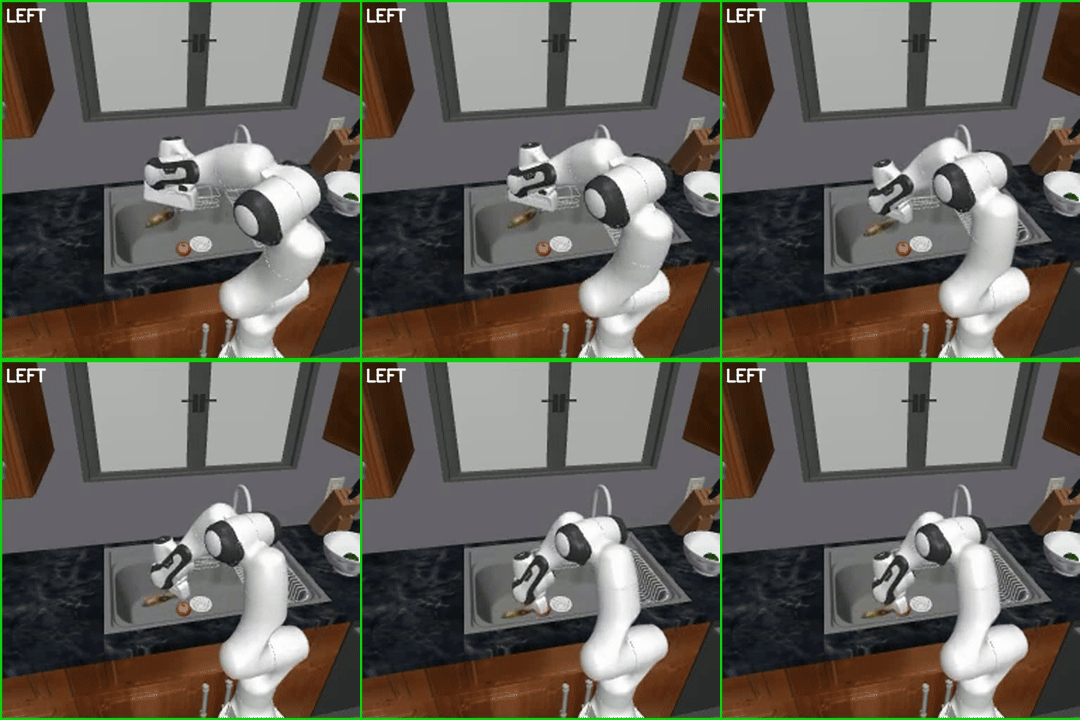
“Move the arm down”

Illustrative demonstration: the robot lowers its arm while holding a banana over the sink.
Baseline
11.1%
Hierarchical
77.8%

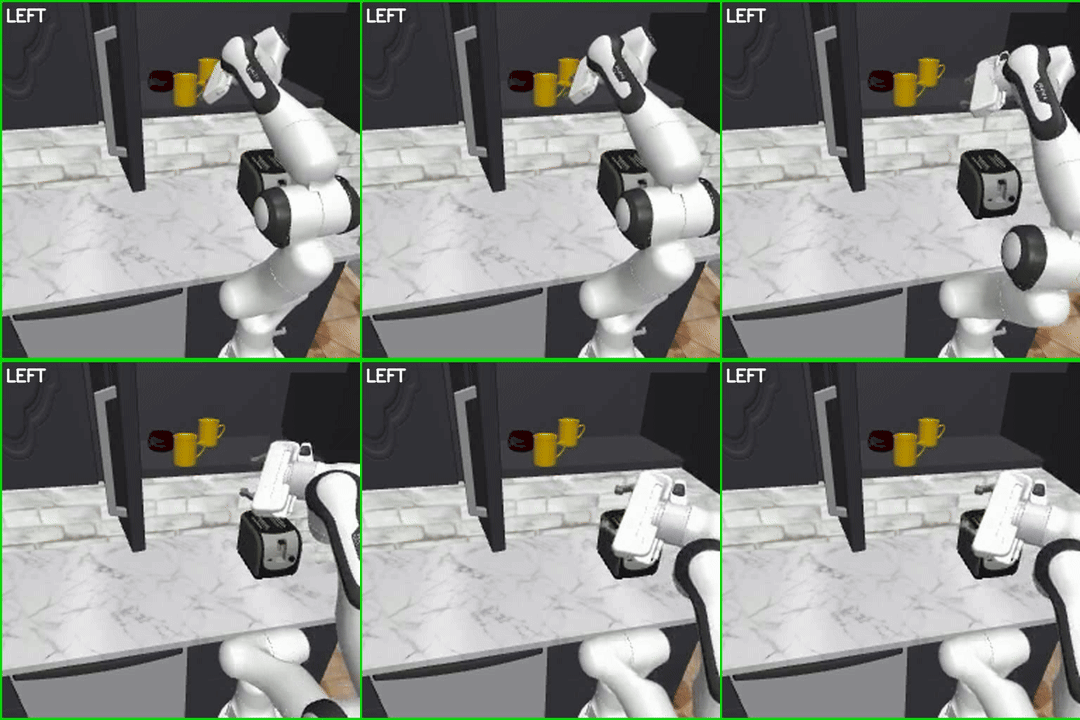
“Move the arm back”

Illustrative demonstration: the robot withdraws its empty gripper from the mug shelf.
Baseline
2.8%
Hierarchical
44.4%

Illustrative demonstrations · Separate compliance evaluation: 36 trials per command, one training seed.

Across planners and phrasings

Highest reported success across all three tested planners, with original and rephrased instructions.

  • Opus 5

    48.8%→47.1%

  • Gemini-3.1-Pro

    46.7%→45.4%

  • Fable 5

    49.2%→48.3%

Original → rephrased success rate · Hierarchical + multi-aspect supervision · RoboCasa 365, seed 42.
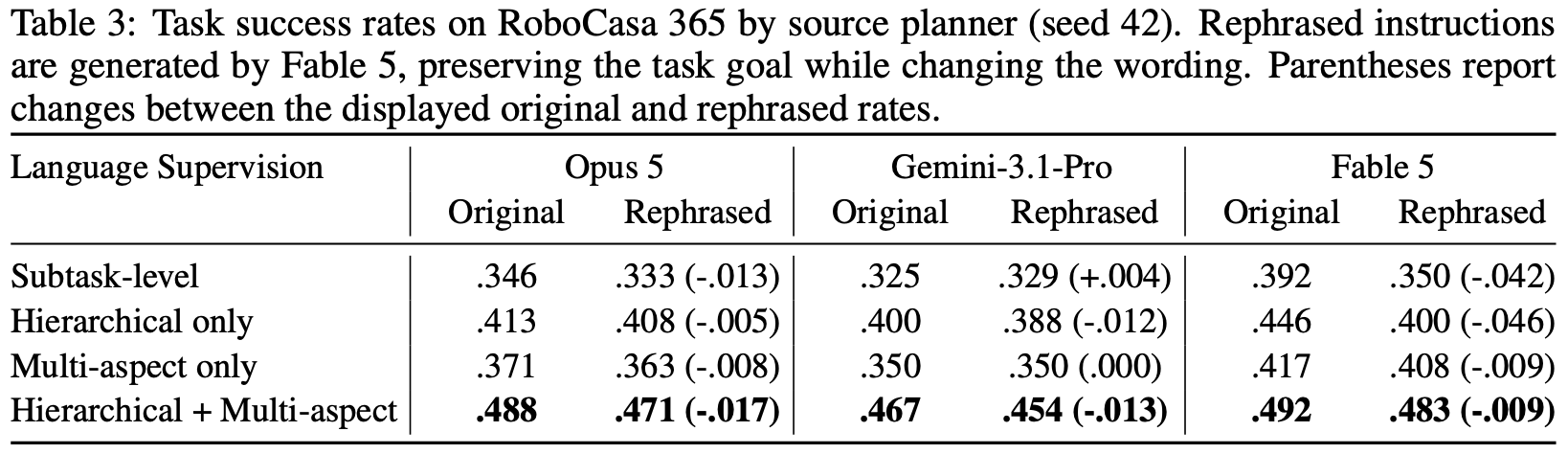
Compare all supervision settings
RoboCasa 365 task success rates, seed 42. Hierarchical plus multi-aspect supervision outperforms subtask-level, hierarchical-only, and multi-aspect-only supervision for Opus 5, Gemini-3.1-Pro, and Fable 5 on both original and rephrased instructions.
Rephrased instructions are generated by Fable 5 and preserve the task goal. View full size.

Both bridges together

Reason, place, and build a physical crossword

Frontier planning and local-policy execution on the physical crossword task.
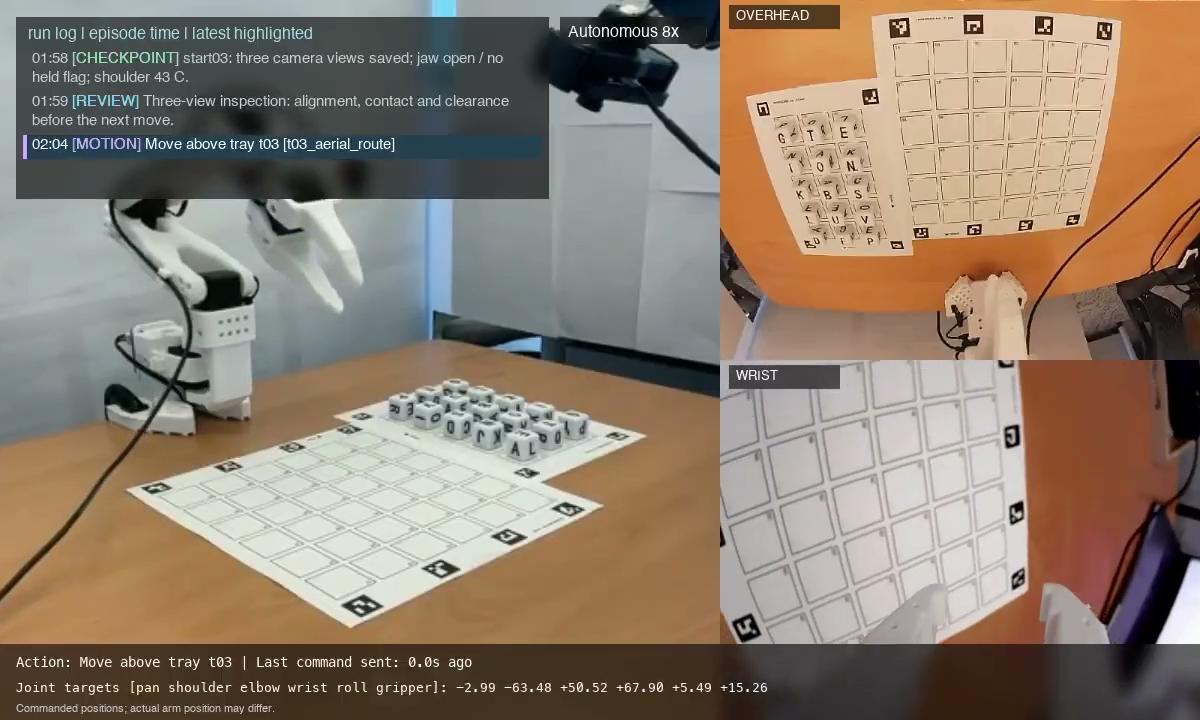
Physical crossword demo: a robot places letter cubes on a board, with overhead and wrist camera views. Demo preview · full video coming soon
Changing the instruction

“Put the cube on 1A.”

“Put the cube to the left of the B cube.”

Dense supervision supports varied spatial descriptions.
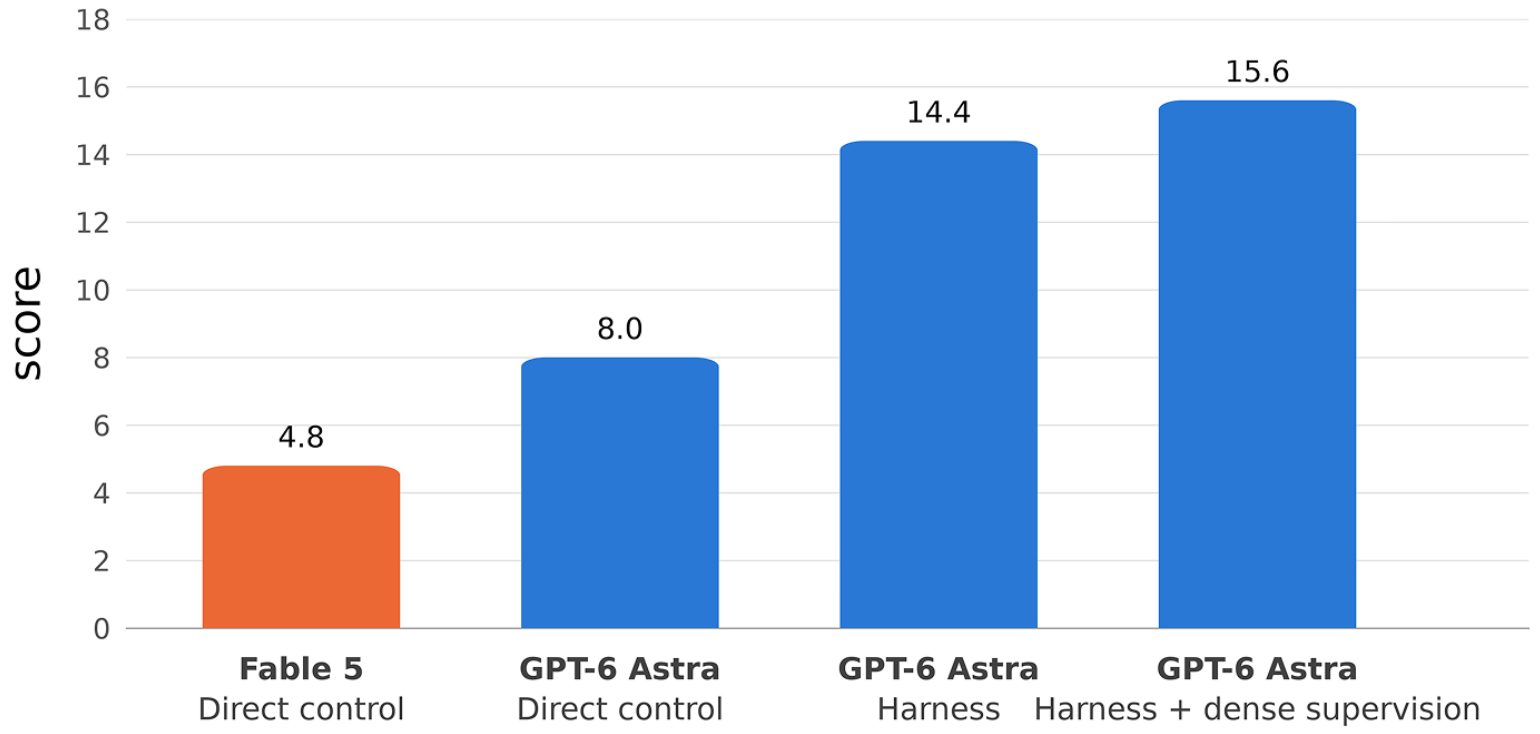
Mean crossword scores: Fable 5 direct control 4.8, Astra direct control 8.0, Astra harness 14.4, and Astra harness with dense supervision 15.6.
Mean score over 5 games · 1-hour budget per game. View full size.

More time acting. Less time waiting.

Direct control2m 40s
Frontier harness9m 8.55s
3.4×time executing actions

Cumulative action time over one hour · one run per configuration.
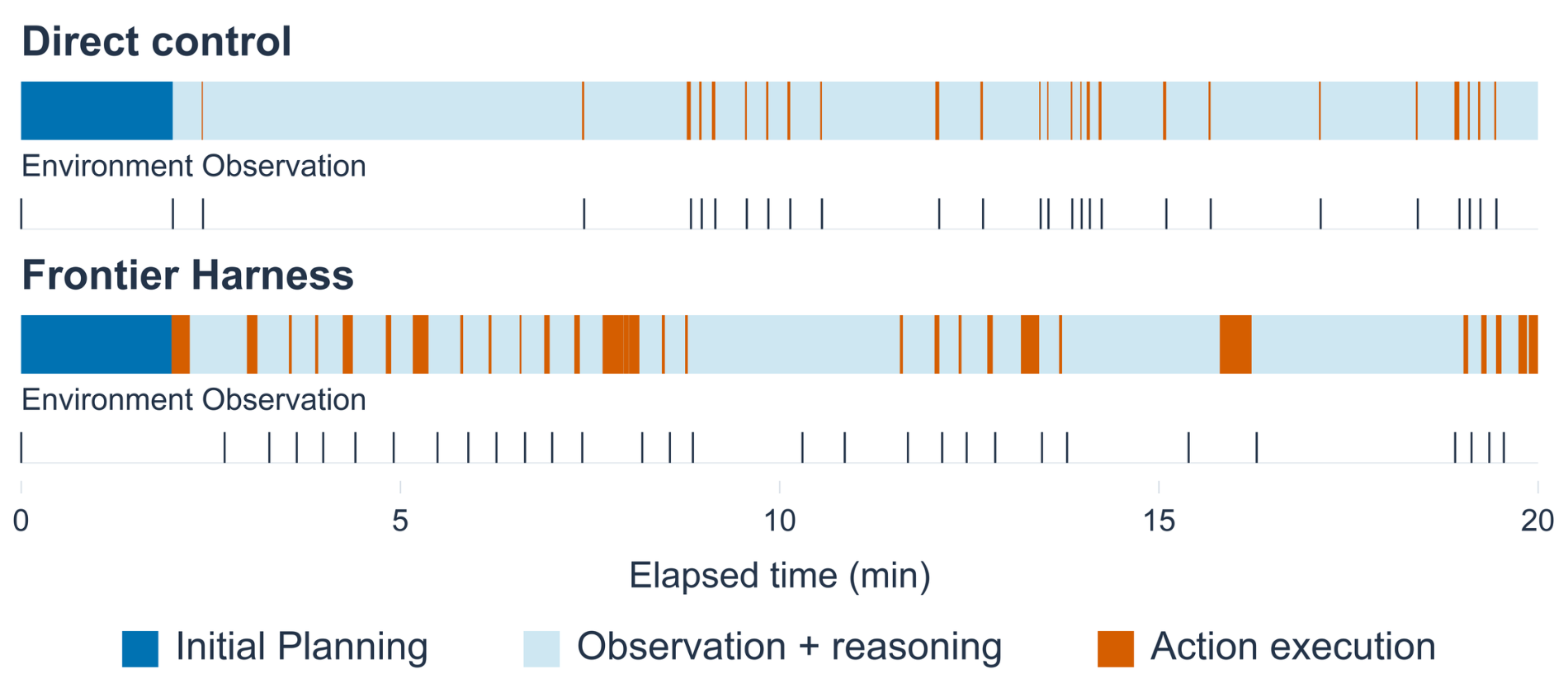
Timeline comparing direct control and the frontier harness: the harness allocates more of the elapsed time to robot action execution.
First 20 minutes shown. Orange: action execution; light blue: observation and reasoning. View full size.Swipe to explore the full figure.

BibTeX

@misc{kim2026bridging,
  title = {Bridging Frontier Reasoning and Robot Execution:
           From Autonomous Demonstration Generation to Dense Language Supervision},
  author = {Kim, Bosung and Trevithick, Alexander and Wang, Ruiyi
            and Ammanabrolu, Prithviraj},
  year = {2026},
  eprint = {2610.03615},
  archivePrefix = {arXiv},
  url = {https://arxiv.org/abs/2610.03615}
}