Beyond Needle(s) in the Embodied Haystack
Environment, Architecture & Training Considerations for Long-Context Reasoning
University of California, San Diego
∞-THOR is a framework for long-horizon embodied tasks that pushes long-context understanding in embodied AI. It provides:
To make agents capable of this, we explore architectural adaptations — interleaved Goal-State-Action modeling, context extension, and Context Parallelism — to equip LLM-based agents for extreme long-context reasoning and interaction. Our results highlight the difficulty of the benchmark and give insight into training strategies and model behaviour under long-horizon conditions.
Existing embodied benchmarks use episodes of a few dozen steps, which rarely require an agent to retain information across the episode. ∞-THOR trajectories run for thousands of steps, so the observations relevant to the final task typically fall outside the context window of current models.
Context is counted the same way as in the paper — roughly 1.45K tokens per interleaved state–action step once a trajectory is converted into the LLM input space. Nothing here is stitched or fast-forwarded: every step is one executed low-level action inside a single continuous episode.
Instead of collecting long demonstrations, we grow them. The generator samples a new task from what the agent can currently reach, plans it symbolically, and executes it in AI2-THOR — appending subgoal after subgoal to a single continuous episode.
A goal type, pickup object, movable receptacle and target receptacle are sampled from the objects the agent can actually see and reach in the current scene state.
The task is compiled into a PDDL problem and solved by a Metric-FF planner into a high-level plan, then expanded into low-level navigation and interaction actions.
Actions are executed in the simulator. Every step logs which objects were visible, pickupable and open — the record that later becomes the haystack.
The full episode is replayed and object IDs repaired. If it no longer reproduces, the last subgoal is discarded and the agent is teleported back to the last valid state.
One command grows trajectories in any floor plan; a second deterministically replays a saved episode into frames at any resolution. Details in the repository README.
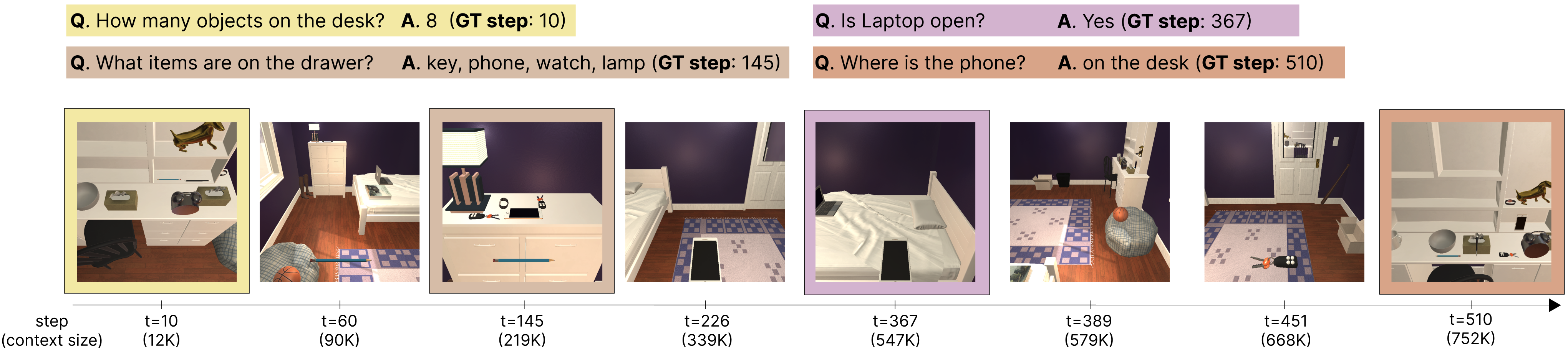
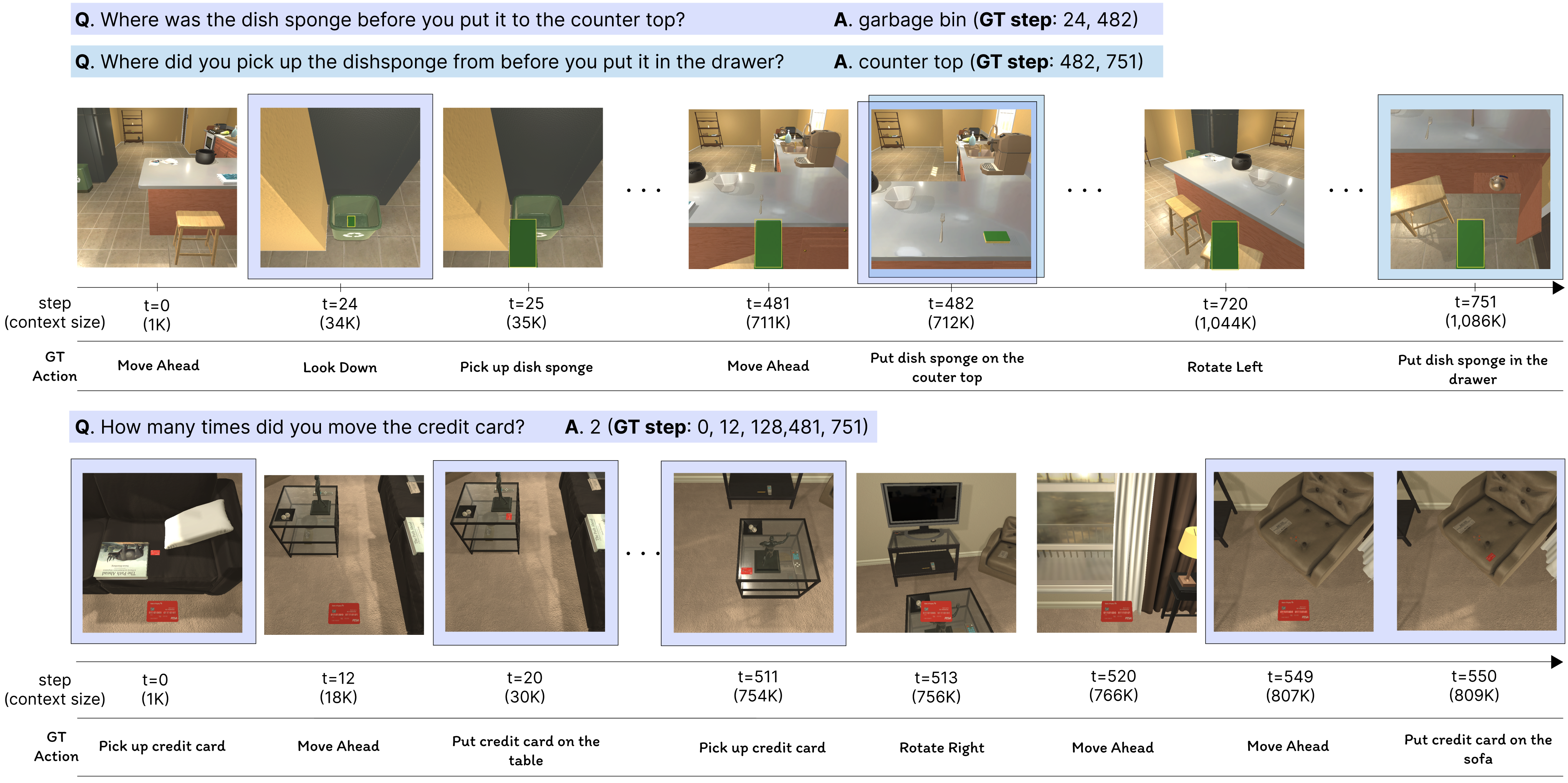
Text needle-in-a-haystack tests hide one sentence in a wall of prose. NiEH is harder in two ways: the clues are multiple and scattered, and the haystack is embodied — a stream of egocentric frames interleaved with the actions that produced them. To answer, an agent has to recall what it saw, where it was, and what it did, hundreds of steps ago.
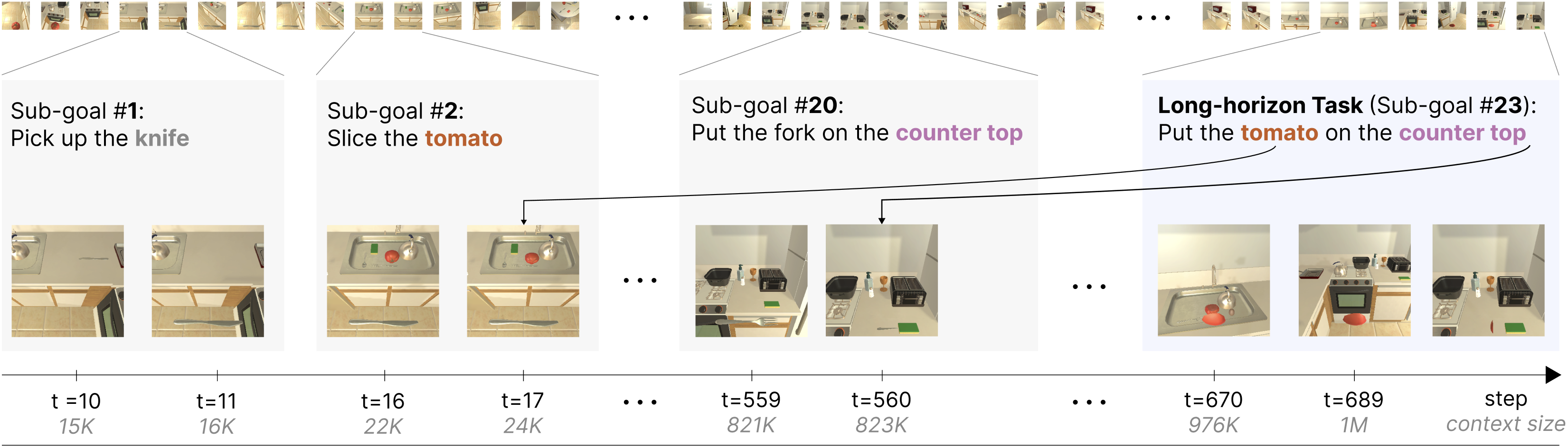
Each test episode ends with a synthetic final task deliberately built from objects the agent encountered at distant, unrelated moments. Below, the tomato is seen at t = 17 and the counter top at t = 560; the goal arrives at t = 670. Completing the task therefore requires retaining observations across the full episode, rather than reasoning over recent context alone.
Beyond QA, agents are evaluated online in AI2-THOR on the final long-horizon task of each test trajectory — acting in the environment with the preceding hundreds of steps as their history. Results are reported for fine-tuned Qwen2.5-VL.
| Method | Go to | Pick up | Put | Total |
|---|---|---|---|---|
| Memory-Augmented (Text) | 10.8 | 1.5 | 0.0 | 6.1 |
| Memory-Augmented (Image, Top-20) | 6.2 | 0.0 | 0.0 | 3.1 |
| Interleaved Goal-State-Action (32K) | 11.3 | 1.5 | 0.0 | 6.4 |
| Interleaved Goal-State-Action (128K) | 18.5 | 2.3 | 0.0 | 9.2 |
| + Dynamic Scaling | 20.0 | 2.3 | 0.0 | 9.9 |
| + YaRN (×4) | 23.1 | 2.6 | 0.0 | 11.5 |
Success rate (%) on the long-horizon task; 32K / 128K is the context length used during fine-tuning. Two things stand out. Interleaved beats retrieval — processing the continuous history works better than searching a memory of it. And more context is worth a lot: 32K → 128K nearly doubles the total, with YaRN pushing it to 11.5%. But the Put column is zero everywhere — it is the last stage of the task, and agents almost never survive the earlier ones to reach it. Long-horizon embodied control is wide open.
Feeding the entire trajectory to a VLM and asking a NiEH question. Models whose pretraining context cannot span the episode do not degrade gracefully — they collapse to zero. Even the strongest models lose most of their accuracy the moment an answer needs two distant observations instead of one.
| Model | Single-evidence | Multi-evidence |
|---|---|---|
| LLaVA-OneVision (7B) | 0.00% | 0.00% |
| DeepSeek-VL (7B) | 0.00% | 0.00% |
| Qwen2.5-VL (7B) | 47.35% | 36.60% |
| Gemini 2.0 Flash | 67.36% | 30.94% |
LLaVA-OneVision and DeepSeek-VL fail to handle contexts beyond their pretraining limits. Note that the best single-evidence model is not the best multi-evidence one: retrieving one needle and reasoning over several are different abilities.
We ship a torchtitan-based trainer with Tensor, Data and Context Parallelism so a 7B VLM can be fine-tuned on sequences long enough to hold a real trajectory.
| Config | Parallelism | Sequence length | Use case |
|---|---|---|---|
| ft_llava_ov_7B_tp4_dp2 | TP4 × DP2 | 32K | default 8-GPU setup |
| ft_llava_ov_7B_tp2_cp2_dp2 | TP2 × CP2 × DP2 | 64K | long-context training |
| ft_qwen_25vl_7B_infini_cp8 | CP8 × FSDP | 32K | 8-way context parallelism |
| ft_qwen_25vl_7B_infini_cp16 | CP16 × FSDP | 128K | very long sequences |
Every episode below was generated by the same script, in a different floor plan, with no human in the loop. Hover to play.
Generation framework, NiEH benchmark, long-horizon training data, model checkpoints and the torchtitan-based training stack — all public. The README walks through evaluation, generation and training end to end.
@article{kim2025infinithor,
title = {Beyond Needle(s) in the Embodied Haystack: Environment,
Architecture, and Training Considerations for Long Context Reasoning},
author = {Kim, Bosung and Ammanabrolu, Prithviraj},
journal = {arXiv preprint arXiv:2505.16928},
year = {2025},
url = {https://arxiv.org/abs/2505.16928}
}